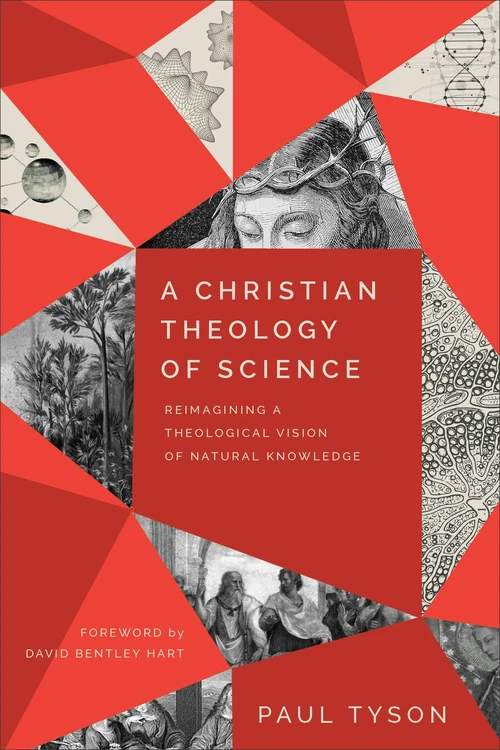
A Christian Theology of Science
- Theology
- Apologetics
- Science & Faith
- Publisher: Baker Academic (Baker Publishing Group)
- Published: 2022
FritzSearch.com earns a commission on purchases made through Bookshop.org links.
Publisher's Description
An author on the cutting edge of today's theology and science discussions argues that creedal Christianity has much to contribute to the ongoing conversation. This book contains an intellectual history of theology's engagement with science during the modern period, critiques current approaches, and makes a constructive proposal for how a Christian theological vision of natural knowledge can be better pursued. The author explains that it is good both for religion and for science when Christians treat theology as their first truth discourse. Foreword by David Bentley Hart.
Endorsements (7)
“This is a bold book, destined to become a classic. Cutting through the clutter of worn-out science-and-religion debates, Paul Tyson reclaims theology as the first truth discourse that tells us what science is and how it should function. Rather than look through the lens of science to theology, A Christian Theology of Science turns the telescope around and asks us to consider the scientific implications of creedal Christianity. Tyson’s book is both erudite and lucid. Rarely have the foundations of modern science been subjected to a more penetrating critique.”
“For decades, the disciplines of theology and science were in open conflict, banal agreement, or mutual isolation. In this work, Paul Tyson reimagines their engagement with great clarity and erudition to provide a theological analysis of science as the knowledge of nature. This is an excellent and timely book which significantly enhances our understanding of the natural sciences and their relation to theology, history, and metaphysics.”
“Tyson argues that the City of God must operate on its own terms rather than on those of the City of Man. This demands that it find the courage to recover Christian theology as a first truth discourse with an associated Christian theology of science. This work offers a highly lucid account of how to begin the recovery operation. It is likely to become a classic text bridging several disciplines.”
“This book enters territory that has long been awaiting intelligent attention, not because it is a forgotten backwater but because it is a no-man’s-land, caught between self-interest and fear. Tyson is a trusty guide, navigating a minefield with secure footing in metaphysics, showing how the assumptions behind nineteenth-century science and religion have cordoned off parts of our lives and corralled them into separate camps. He characterizes those camps and their various relationships and highlights flaws in the assumptions that led us into them. He suggests a way out, guided by light, Plato and Augustine, Aristotle and Aquinas, and Socrates. Tyson’s overview is crystal clear. He wears his impressive learning lightly, and his footnotes and references are extensive. This book is highly original and deserves a wide readership.”
“One of the basic tasks in the effort to help bring about a genuine paradigm shift in a culture’s way of understanding some fundamental idea is to articulate the new approach in a succinct and compelling manner, accessible to any reasonable person with or without any special expertise. This is just what Tyson accomplishes with this new book, which represents a significant moment in the growing concern to rethink and indeed reorder the relationship between ‘science’ and ‘religion.’ In this powerful little text, Tyson clears away the myths that continue to rule the popular imagination and replaces them with lucid, theologically and metaphysically nuanced insights that resonate with undeniable truth.”
“Panoramic in its breadth and stunning in its depth, Tyson’s genealogy exposes our often-hidden presumptions regarding our fraught discussions on faith and science. This book equips people of faith and people of science with the right infrastructure for each to come to a true and fruitful encounter with the other. This could very well become the standard text for courses on this crucial crosspoint.”
See something wrong on this page? Report a problem