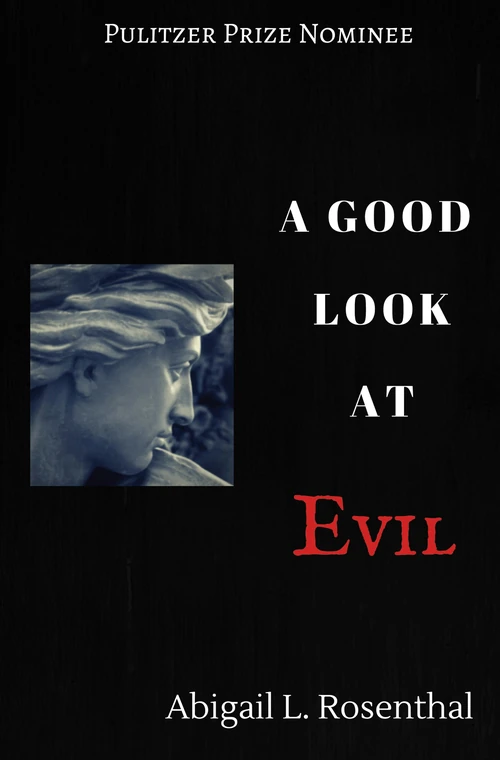
A Good Look at Evil
- Philosophy
- Publisher: Wipf and Stock
- Published: 2018
FritzSearch.com earns a commission on purchases made through Bookshop.org links.
Publisher's Description
We meet with evil in the ordinary course of experience, as we try to live our life stories. It's not a myth. It's a mysterious but quite real phenomenon. How can we recognize it? How can we learn to resist it? Amazingly, philosophers have not been much help. Despite the claim of classical rationalists that evil is "ignorance," evil-doers can be extremely intelligent, showing an understanding of ourselves that surpasses our own self-understanding. Meanwhile, contemporary philosophers, in the English-speaking world and on the Continent, portray good and evil as social constructs, which leaves us puzzled and powerless when we have to face the real thing. Thinkers like Hannah Arendt have construed evil as blind conformity to institutional roles--hence "banal"-- but evil-doers have shown exceptional creativity in bending and reshaping institutions to conform to their will. Theologians have assigned evil the role of adversary to the divine script, but professing religionists are fully capable of evil, while atheists have been known to mount effective resistance. More than broad-brush conceptual distinctions are needed. A Good look at Evil maps the actual terrain--of lived ideas and situations--showing how to recognize evil for what it is: the perennial and present threat to a good life.
Endorsements (9)
“Reading a book without filtering it through the biases and fears of one’s own time is difficult enough, and you’d think that a book with a focus on the concept of “evil” would be able to analyze its topic in a mutually shared understanding if not objective definition that would hold up across time and cultures. And you’d be wrong about all of that. Evil, perhaps like stupidity, is not easily defined. Wouldn’t you just assume that something as pervasive, menacing and potentially (if not actually) personally and socially destructive as “evil” would be immediately recognized, like the emergence of some lethal bacterial invader, and dealt with as fully and comprehensively as possible at its first sighting? But no, evil – on levels we can barely recognize – on a scale sometimes not too small, but too large – loom over any and every society now and then, and like any pernicious disease, no one is immune and every society, no matter its safeguards, is vulnerable. And like any infectious disease, evil begins slowly, takes a foothold and expands, slowly and barely noticeable at first and then, if not recognized, begins to flourish in dark and neglected plae and finally emerges strong and resistant. Like the great plagues, forms of evil can define an era or a culture. And evil, like disease, (or even stupidity) is no abstraction. Evil distorts, deceives, captivates, and ultimately consumes its victims, which again, can be any of us. This book is not for everyone. Some will find it hard to read, others will discover that they, despite their denials, justifications and protestations, actually love and cultivate evil. Eventually they, and possibly we, will pay the cost, but until they go off the proverbial cliff or enter the fire and fury of their own making, they will preserve their “opinion” or “values”. Hell, I am sure, is packed with people defined by their certainty and “faith” in some unyielding cause or convincing personality. We have seen this many times before, we will see it again – and, I am convinced, we are seeing it right now. It’s hard for me to believe that this book was written over thirty years ago, its warnings – and examples – could have been taken from today’s front pages and today’s cast of characters eager to convince, cajole and frighten us into believing the worst of each other- and ourselves. In America in particular, a land which has (almost) always prided itself on being a land of justice, equality and opportunity, evil – obvious, tangible and blatant evil, has taken root and flourished to a degree most of us never would have imagined possible. Many people I know have rushed to embrace it. They are intoxicated and inspired by it. They, like the devotees of Ceasars, Kaisers and Fuhrers before them are convinced that they know “the One” who will save them. Their rush to their own ashes is truly frightening. And history shows us that the destruction they wreak will not only be their own. Unlike Hannah Arendt, Rosenthal does not believe that evil is banal – she is convinced that it is intentional – an intentional thwarting – if not destruction – of the narrative, the story we tell ourselves about who we are as individuals, as a culture as a nation. The stories I grew up with – of my country (USA) and faith (Christianity) could not feel more alien than the distortions I currently see and hear constantly. Where is the America that told itself – and the world – that it was the welcoming home of fugitives and refugees from persecution and oppression? Where is the faith that held up compassion and generosity as ideals – not as signs of weakness. America was the land of opportunity and a place where laws were applied equally. Now it has become a haven for crude, destructive opportunists. We have been lied to, and our own story has been taken from us. That, in summary, in Rosenthal’s definition of evil – the distortion of one’s story beyond recognition – and the seduction (sometimes literal) that accompanies it. And, according to Rosenthal, the techniques and strategies are as universal as they are effective; her first model is that of the “seducer”. The “seducer” takes what he wants, has no respect, or even recognition of laws, rules or social guidelines. He has no friends. He has no need for friends. Each person on his social landscape is an ally, an obstacle or a potential victim. He has no equal, no peers. Just as he is oblivious to standard societal guidelines, he is also, by wealth, charm or deception, immune from the consequences of violating them. He has no beliefs or values – just the continual search for the next conquest. And like a true “seducer”, no victim holds his attention for long. He seeks continual “re-entanglements”. It is difficult to imagine a more purely destructive force in any relationship, family, community or political body. And yet he acquires many who seek to profit from his powers — if only they too can escape being scorched and discarded. We see few of these acquire public power and prominence in human history, perhaps one or two a generation. And that is more than enough. As you might guess from any study of evil, the author takes some close looks at what she calls “the unalloyed evil” of the Nazi era. Even a couple of generations later, the immensity of that “movement” is breathtaking and inconceivable to most us. The idea of rounding up, incarcerating and executing people, for no reason except their racial/ethnic identity, on a socially acceptable set of beliefs and on an industrial scale – in other words murder and exile that was socially supported – if not cheered – and backed up by state authority was something the world had never seen before, and, it was presumed would “never again” see. As with the Nazis, any era that embraces and embodies such philosophies and techniques loses its own humanity first. All that needs to be said, and embraced, is “Never again!”.”
“Abigail Rosenthal is a professor (emerita) of philosophy, which is not the same thing as being a real philosopher. Indeed, there are few enough books written today by genuine philosophers. This is one. … Any book with the title, A Good Look at Evil looks to be heavy going, but Rosenthal’s treatment of an undoubtedly important philosophical problem is remarkably accessible to anyone who still retains a hold on common sense. ... This is, then, a genuine and practical philosophy of existence, a recovery of the understanding of philosophy as a way of living.”
“Rosenthal writes in a distinctive philosophical voice that models personal interest in the moral quality of life, with the vividness and candor that this implies (and also considerable wit and humor) … . Evil can be not merely the sad effect of compromises and evasions but a bright, hot, self-nourishing interest in the kind of personal superiority that one realizes by laying waste to others. If we held evil to be merely a general criterion for the moral evaluation of practice and avoided pinning it to any real individual, we would miss the very phenomenon that forces us to reckon with evil as distinct from what is merely regrettable or deficient in our lives—a phenomenon with an alarming human concreteness.”
“Abigail Rosenthal has given us the definitive — the defining — account of evil and, at the same time, of the good life that evil subverts. Evil is not banal, but quite the opposite. It targets its victim with precision and ruthlessness.”
“Abigail Rosenthal proposes a new way of understanding one of the oldest mysteries—the nature of evil. Drawing on wide literary and philosophical resources, Rosenthal proposes that narrative self-understanding is the key to a good life. She traces the implications of this idea for understanding various types of evil, including the ultimate evil of Nazi genocide—which, she argues, cannot be understood in Arendtian terms as a kind of banality. Highly personal and original, Rosenthal's work offers new ways of grappling with some of the largest ethical questions.”
“Rosenthal pinpoints the characteristic feature of evil—at least the leading type of evil—that distinguishes it from what is only morally wrong or very, very bad. It is based on her basic notion of an ideal ‘life story’ or plot. She extends both concepts from individual victims to races and populations as victims. [T]here is nothing banal or ordinary about evil, the intentional disrupting of the victim’s ‘ideal thread’ or plot. … In a fascinating new essay, Rosenthal revisits Hannah Arendt . . . applying her “plot” concept to Arendt herself in light of what is known about Arendt's long intellectual and personal relationship with Heidegger. Rosenthal argues that despite a splendid recovery from early adversity, Arendt went on to ‘spoil’ her own life story. And in a concluding piece, Rosenthal shows from her own experience how one can have reason to believe that a person's life story has been co-authored by God.”
“It is a most compelling and creative work. Rosenthal is analyzing the ‘stories’ that people tell us about themselves, in terms of both their lives and their work. She does so in an effort to understand genocidal evil-doers, both those who perpetrate and collaborate with it and those who cover up such crimes.”
“A Good Look at Evil is not only an examination of evil but proposes a new way to think about our own lives. By adopting a literary approach to a philosophical question, Rosenthal has provided genuine insight into a problem that has befuddled thinkers for ages. Evil is not an abstract concept but a lived reality and situation in which we encounter. If you wish to understand evil as well as to know how to live your life, A Good Look at Evil is a perfect way to begin writing your own story.”
“Edmund Burke famously said, “The only thing necessary for the triumph of evil is that good men do nothing.” Abigail Rosenthal’s book, A Good Look at Evil, takes it one step further. The only thing necessary for the triumph of evil is to pretend that it doesn’t exist! A Good Look at Evil, then, is a remarkable and incisive exploration of the human condition. My compliments to the author, Abigail Rosenthal, for her thoughtful and inspiring book. No wonder this book was nominated for a Pulitzer Prize.”
See something wrong on this page? Report a problem