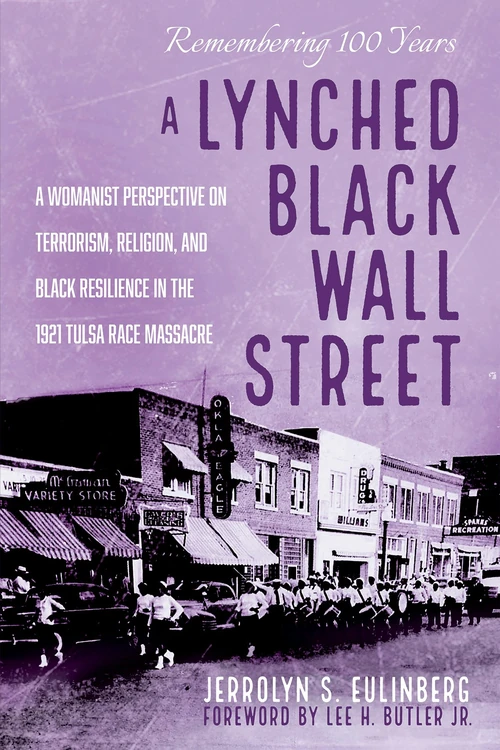
A Lynched Black Wall Street
A Womanist Perspective on Terrorism, Religion, and Black Resilience in the 1921 Tulsa Race Massacre
- Ethics, Culture & Social Issues
- History & Biography
- Publisher: Cascade Books (Wipf and Stock)
- Published: 2021
FritzSearch.com earns a commission on purchases made through Bookshop.org links.
Publisher's Description
This book remembers one hundred years since Black Wall Street and it reflects on the 1921 Tulsa Race Massacre. Black Wall Street was the most successful Black business district in the United States; yet, it was isolated from the blooming white oil town of Tulsa, Oklahoma, because of racism. During the early twentieth century African-Americans lived in the constant threat of extreme violence by white supremacy, lynching, and Jim and Jane Crow laws. The text explores, through a Womanist lens, the moral dilemma of Black ontology and the existential crisis of living in America as equal human beings to white Americans. This prosperous Black business district and residential community was lynched by white terror, hate, jealousy, and hegemonic power, using unjust laws and a legally sanctioned white mob. Terrorism operated historically based on the lies of Black inferiority with the support of law and white supremacy. Today this same precedence continues to terrorize the life experiences of African-Americans. The research examines Native Americans and African-Americans, the Black migration west, the role of religion, Black women's contributions, lynching, and the continued resilience of Black Americans.
Endorsements (3)
Foreword
“Jerrolyn Eulinberg takes a fresh look at the historical data surrounding the Tulsa Race Massacre. . . . Using a Womanist interpretive lens and the religious ritual of lynching, she reexamines the details of the massacre to offer new insights on the theology, morality, and hate that mediated the razing of Greenwood while never losing sight of the communalism and resiliency of its residents.”
“Dr. Jerrolyn Eulinberg balances a finely detailed microhistory of the tragic 1921 Tulsa Massacre with a wide-ranging exploration of history, ethics, and sociological and theological resources. This astute project helps us not only recognize the depth of this tragedy and its ongoing impact on its survivors and their descendants, but also compels readers to pay attention to this horrifying, yet often hidden, enduring legacy of America’s racist past. Eulinberg’s work contributes significantly to a wide readership, from academy and church, as she faithfully attends to the truths the dark past has taught us. With both head and heart, she boldly provides a testament to the voice of the voiceless.”
“In this seminal book, Jerrolyn Eulinberg combines Womanist wisdom, sharpened analytical prowess, and depth of meaning to reveal the systematic structure that continues to inscribe inequality for African Americans in this country. . . . A solid contribution to the body of literature pointing to the systemic nature of violence embedded in the American fabric. . . . I expect this work to populate religious studies departments, divinity schools, and seminaries as the only scholarly work to evaluate the Tulsa Race Massacre for its religious and spiritual dimensions.”
See something wrong on this page? Report a problem