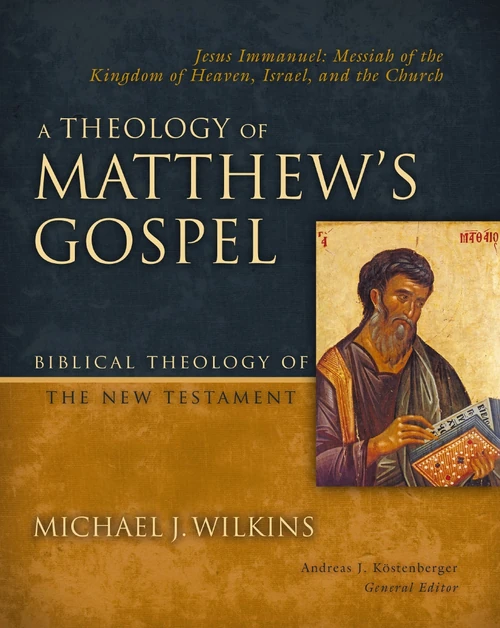
A Theology of Matthew's Gospel
Jesus Immanuel: Messiah of the Kingdom of Heaven, Israel, and the Church
- Biblical Studies & Commentaries
- Publisher: Zondervan Academic (Zondervan)
- Published: 2025
FritzSearch.com earns a commission on purchases made through Bookshop.org links.
Publisher's Description
A Theology of Matthew's Gospel develops the perspective that Matthew wrote his Gospel to identify, defend, and proclaim Jesus Immanuel, "God with us," as the Davidic Messiah who fulfilled the OT expectations of humanity's redemption. Matthew's Gospel establishes Jesus's identity as the heir to the promises of Israel's throne through king David, and heir to the promises of blessing to all the nations through the patriarch Abraham (1:1). So, this first Gospel offers evangelistic hope in Jesus's message of the gospel to Jews, contending that they should turn to Jesus as their long-awaited Messiah (Matt 11:2-6). But, strikingly, Matthew's Gospel also offers evangelistic hope to Gentiles, emphasizing that salvation through Jesus Messiah is available to all the nations (28:19). The book emphasizes the three horizons that comprise Matthew's gospel: history, theology, and literature. The first horizon focuses on Jesus's historical ministry. Here Matthew provides for us a record of God's activities in history in the arrival of Jesus Messiah and the kingdom of heaven. The second horizon develops Matthew's theological perspective for his audience(s). Here we attempt to understand and isolate Matthew's unique theological perspective of God's activities in Jesus Messiah. This is a central focus, emphasizing Matthew's theological perspective of the Old Testament, Christology, the kingdom of heaven, discipleship, the Church/church, Israel (past, present, and future), the death and resurrection of Jesus, mission/commission, and eschatology/eternity. The third horizon emphasizes today's reader(s) engaging with Matthew's Gospel as literature. Here we attempt to capture the significance of the perspective of today's reader's understanding of Jesus Messiah's activities in history and Matthew's theological perspective for the contemporary church. In this book we view Matthew's perspective of God's activities in Jesus's unfolding earthly ministry. The alternating sections of narrative and discourse provide for his readers Jesus's example to follow and Jesus's words to obey. Therefore, Matthew's Gospel is at least in part a manual on discipleship to Jesus Messiah in the kingdom of heaven. In the six Narratives, Matthew reveals Jesus's true identity in his deeds, and introduces themes that will lead to instructions to Jesus's disciples in the Discourses. The six Narratives provide the example that Jesus's disciples are commanded to obey. In the five Discourses, Matthew records Jesus's instructions, commands, parables, directives and prophecies that will guide his followers in their discipleship to Jesus until the end of the age. Combined, the narratives of Jesus's life provide Jesus's example to follow, and the discourses give Jesus's instructions to obey, and are the basis of our ongoing transformation to become like Jesus.
Endorsements (1)
“PRAISE FOR A THEOLOGY OF JOHN’S GOSPEL AND LETTERS For the comprehensiveness of its coverage in the field of Johannine theology (gospel and letters), there is nothing to compare to this work. D. A. CARSON, research professor of New Testament, Trinity Evangelical Divinity School This book is a “first” in many ways: the first volume that sets the pattern for the quality and style of the new Biblical Theology of the New Testament series published by Zondervan; the first major volume to be devoted specifically to the theology of John’s gospel and letters at a high academic level; and the first volume to offer a thorough interpretation of the theology of an eyewitness of the life and passion of Jesus. Andreas Köstenberger has already laid a foundation for his study with his careful, detailed commentary on the gospel of John, and here presents a self-standing study that gathers together the thought of the Evangelist in a systematic and complete manner. I particularly welcome the way in which the book sets out John’s theological story in the gospel and letters before giving a detailed, thematic study I. HOWARD MARSHALL, emeritus professor of New Testament exegesis and honorary research professor, University of Aberdeen Massive and masterful, this book presents Johannine theology in encyclopedic fullness. Arguing for apostolic authorship of John’s gospel and epistles, Andreas Köstenberger gives due weight to historical, literary, linguistic, and thematic matters in careful interaction with other scholars. Yet pastors and advanced students will also find the discussion accessible. We find here a new benchmark in synthetic treatment of these priceless writings of Christ’s beloved disciple. ROBERT W. YARBROUGH, professor of New Testament, Trinity Evangelical Divinity School To the Word-Made-Flesh “And since they all [i.e. all four canonical Gospels] had the same object, to show Christ, the first three exhibit His body, if I may be permitted to put it like that, but John shows His soul.”
See something wrong on this page? Report a problem