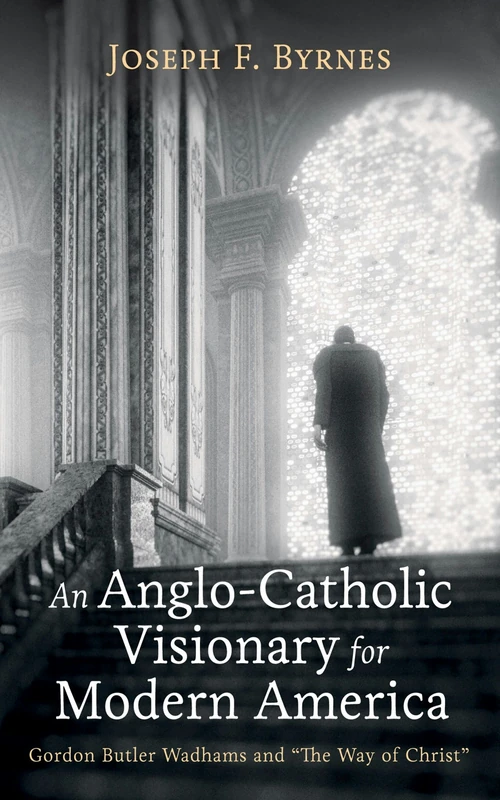
An Anglo-Catholic Visionary for Modern America
Gordon Butler Wadhams and “The Way of Christ”
- History & Biography
- Publisher: Wipf and Stock
- Published: 2023
FritzSearch.com earns a commission on purchases made through Bookshop.org links.
Publisher's Description
"Anglo-Catholic" is not an abstract label for Father Gordon Butler Wadhams, the vibrant personality whose life is narrated and whose writings are anthologized here. In the Episcopal (Anglican) Church, Anglo-Catholicism attracts, repels, confuses, and has a variety of meanings that Wadhams sorted out across the years as an Episcopal and a Roman Catholic priest. Joseph F. Byrnes here presents and clarifies his writings on the church and ecumenism, the liturgy, the Bible, and Christian mission. The lifelong Anglo-Catholic vocation of Gordon Wadhams was marked by inspiring family experiences, enlivened by his own youthful experiments with churchgoing and focused by his friends and mentors, Episcopal and Catholic. His timeline cannot be our own, but it serves as a template for our own search to understand how the church is built up by ecumenism, how its liturgy develops by acculturation of timeless traditions, how it valorizes the biblical writings for each generation, and how it inspires the rejection of war, elimination of racism, and dedication to the intellectual and physical well-being of all.
Endorsements (2)
“Joseph Byrne’s splendid book, An Anglo-Catholic Visionary for Modern America, is a real contribution to a number of fields: history of the Catholic Movement in the Episcopal Church, the story of converts to the Roman Catholic Church, showing the beginnings of the Liturgical Movement which in many cases led directly to changes at Vatican II, and certainly the story of a unique, inspiring, and spiritually influential priest in both communions. I hope this book finds wide readership.”
“Joseph Byrnes’s An Anglo-Catholic Visionary for Modern America presents an anthology of periodical writings by the Rev. Gordon Butler Wadhams, accompanied by a biographical appreciation. It should make interesting and challenging reading for any seriously minded Christian and should be especially commended to three different subsets of the Christian church: first, to contemporary Episcopalians who would identify themselves (if pinned down) as broad church, low church, or progressive; second, to thoughtful Roman Catholics; third, to contemporary Anglo-Catholics.”
See something wrong on this page? Report a problem