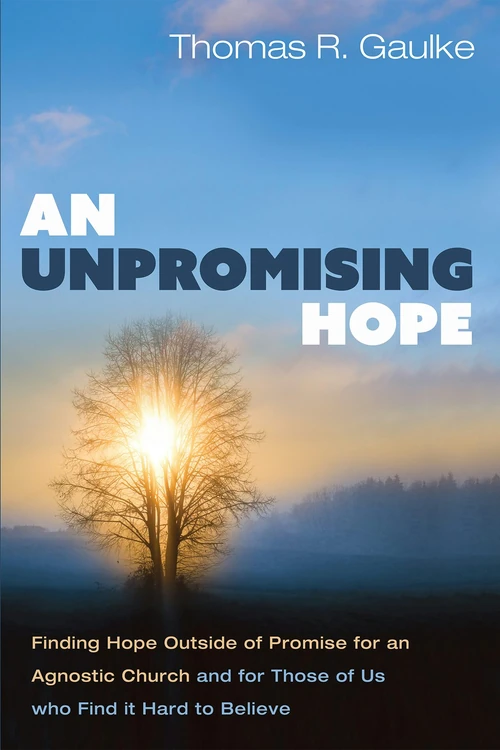
An Unpromising Hope
Finding Hope outside of Promise for an Agnostic Church and for Those of Us who Find it Hard to Believe
- Theology
- Publisher: Pickwick Publications (Wipf and Stock)
- Published: 2021
FritzSearch.com earns a commission on purchases made through Bookshop.org links.
Publisher's Description
Written in a theopoetic key, this book challenges Christian reliance on the motif of promise, especially where promise is regarded as a prerequisite for the experience of hope. It pursues instead an unpromising hope available to the agnostic or belief-fluid members and leaders of faith communities. The book rejects any theological judgement about doubt and hopelessness being sinful. It also rejects any hope which is grounded in a sense of Christian supremacy. Chapter 1 focuses on Ernst Bloch's antifascist concept of utopian surplus, putting Bloch in conversation with queer theorist Jose Esteban Munoz and womanist theologian M. Shawn Copeland. Chapter 2 explores the saudadic and theopoetic hope of Rubem Alves. Chapter 3 turns to the womanist theologies of Delores Williams, Emilie Townes, and A. Elaine Brown Crawford. Finally, chapter 4 engages the post-colonial eschatology of Vitor Westhelle, framing hope as nearby in space, rather than nearby in time. Each chapter offers an unpromising hope that may be tapped into by those who wish to affirm belief-fluidity in their own communities, and by those who wish to speak of hope honestly, whether or not, at any given moment, they believe in God or in the promises of a god.
Endorsements (5)
“Thomas Gaulke has crafted a striking text that shows his ingenuity as both a theologian and a creative artist. With mastery, he raises questions about unbelief that Christian believers are called to consider as we live in a world with myriad ways of understanding the big questions of life. His insight leads the reader to consider the ways that all lives are part of an ecosystem that is beyond the boundaries of the beingness of humans and other living things. Provocative. Essential reading for these times of un-hope and hope.”
“Thomas Gaulke’s exploration of hope is exactly what is needed in the church today. He weaves together a variety of frameworks for finding and defining hope with brilliant insights and a pastoral heart. As a person of faith who sometimes finds herself despairing, this book is balm for my soul. I can’t wait to share Gaulke’s work with the people I serve.”
“An Unpromising Hope stands squarely at the intersection of rich scholarship and deep pastoral insight. Gaulke enters into a global conversation of theologians and philosophers to explore the questions of hope and hopelessness that are felt so powerfully in contemporary churches and, crucially, at their margins.”
“Two questions guide Thomas Gaulke’s book: Where might we look for hope outside of promise? Where might we find hope for an agnostic church and for those of us who find it hard to believe? In different ways, Gaulke shows us how hope is possible in a space that is, perhaps, closer to the gospel—that is closer to Jesus—than the frail forms of hope we hear everywhere. Against a Christian tradition that seals the promise to a few and circumscribes hope to a proper belief, Gaulke shows us that hope is only possible where hope is not given. The Thomas of this book shadows the Thomas of the Gospel, and the results are strikingly close. Both of them have had a hard time believing, but both have also touched Jesus. Don’t be mistaken: this is a mighty book!”
“Theologies of ‘hope’ have served to frame strong ethical imperatives toward activism for many decades now; however, in an increasingly broken world, we have long needed a more grittily realistic appraisal of how faith can coexist alongside work for justice. Not only does Thomas Gaulke’s book provide such an intensely searching and fearless appraisal of our prospects, but his unflinching realism exists—exuberantly—alongside a virtuoso demonstration of theological creativity and synthesis drawing on spatialized eschatologies, womanist ethics, and liberation narratives enshrined in both theology and popular culture. His book will be especially helpful for activists who are in need both of theological inspiration and of resilience in the absence of guarantees, and should marvelously disrupt theological conversations about hope, its limits, and its horizons in the years to come.”
See something wrong on this page? Report a problem