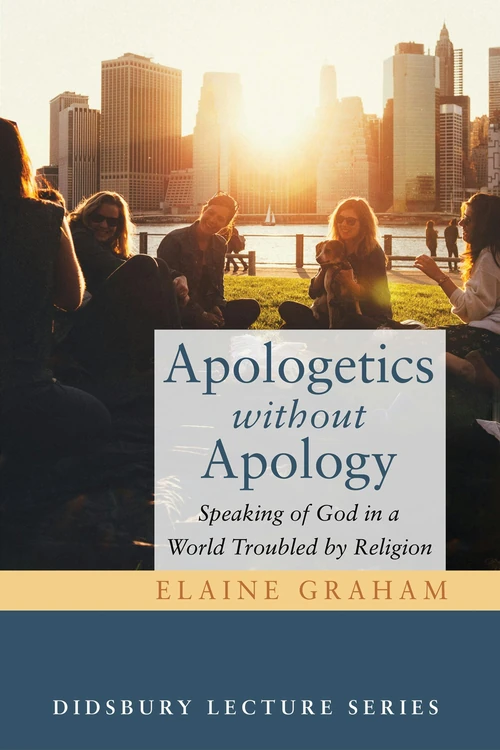
Apologetics without Apology
Speaking of God in a World Troubled by Religion
- Apologetics
- Publisher: Cascade Books (Wipf and Stock)
- Published: 2017
FritzSearch.com earns a commission on purchases made through Bookshop.org links.
Publisher's Description
Against many expectations, religion has not vanished from Western culture. People are troubled and fascinated in equal measure by this new visibility and are unsure whether it is right to (re)incorporate the vocabulary of faith into our common life. This unprecedented co-existence of religion and secularism is sometimes termed the "postsecular," and in this book Elaine Graham considers some of its implications for the public witness of Christianity. She argues that everyone, from church leaders, theologians, local activists, and campaigners, needs to learn again how to "speak Christian" in these contexts. They need to articulate credible theological justifications for their involvement in public life and to justify the very relevance of their faith to a culture that no longer grants automatic privilege or credence. This entails a retrieval of the ancient practice of apologetics, in order to encourage and equip Christians to defend and commend their core principles and convictions in public. This "new apologetics" involves discerning the actions of God in the world, participating in the praxis of God's mission and bearing witness in word and deed. Rather than being an adversarial or argumentative process, this is an invitation to dialogue and to the rejuvenation of our public life.
Endorsements (8)
“With characteristic clarity and erudition, Elaine Graham invites us to see public theology as the new apologetics—not arguing for one’s beliefs against skeptics, but making the case for God’s presence in the world by the lives we live there, shaped by the Christian story.”
“In its dedication to dialogue and the common good, this apologetic performs its sacred obligation by placing love of neighbor at its embodied core.”
“This book convinces the reader that today more than ever the Christian mission must be performed in word and deed, working together with people from other faiths and none for the common good.”
“Building on a lucid examination of our current situation, Elaine Graham convincingly sets out the contours of an ambitious apologetic project that claims to be no less than part of the missio Dei.”
“This book equips us to show hospitality to a plurality of perspectives in churches, broader society, and the academy. Moreover, it strengthens us to impact transformatively upon pluralistic public discourses, public opinion-formation, and public policy processes.”
“How is one meant to ‘speak Christian’ in a post-secular society? In Apologetics without Apology, Elaine Graham furnishes a highly elaborate answer to this urgent question. Building on a lucid examination of our current situation, she convincingly sets out the contours of an ambitious apologetic project that claims to be no less than part of the missio Dei.”
“Graham presented this thesis in 2015 at the famed Didsbury Lecture Series, held annually at Nazarene Theological College, Manchester, UK. She ably explains that we are living in a “postsecular” age. “ “Graham does an admirable job of explaining our current situation, showing how early Christians practiced apologetics, and presenting the form needed now. She ends by insisting that all Christians must learn anew how to “speak Christian” by practicing apologetics not just in words, but also in deeds. Graham is persuasive, clear, and helpful, if a bit redundant at times. Although she is more familiar with the U.K. than U.S. scene, her thesis applies to both worlds. Clergy and lay people, especially those rightly challenged by the complexity of our emerging “postsecular” context, would do well to study this book together and set a new course for explaining and living the gospel.”
“"Elaine Graham’s starting point, in this helpful addition to her writings on the place of theology in the public square, is the baffling paradox of the current position of religion in Western society. . . . She perceptively portrays the contemporary cultural landscape as 'characterized by contradictory and unprecedented currents of religious pluralism and diversification, coupled with institutional decline and strong resistance to expressions of religion in public.’ . . . I find her vision of apologetics convincing: ‘to provide a plausible and compelling vision of faith that is capable of overcoming skepticism and speaking to people’s enduring quest for wonder and meaning,’ and I endorse her insistence that developing such an apologetic is a top priority for Christians today.”
See something wrong on this page? Report a problem