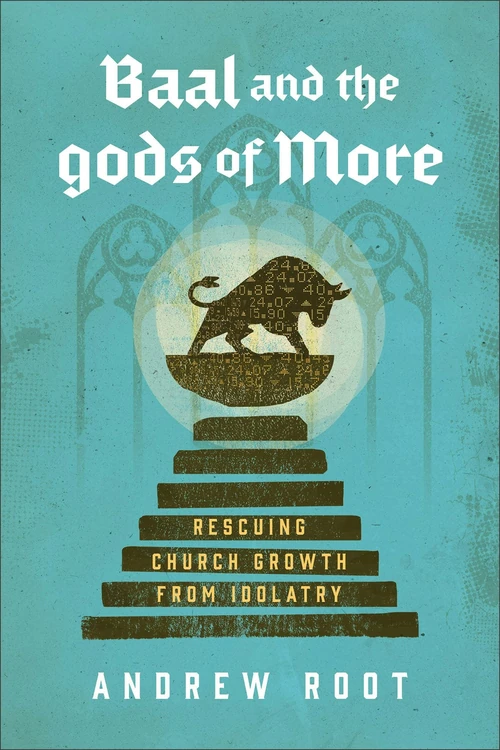
Baal and the Gods of More
- Theology
- Church Leadership & Ministry
- Publisher: Baker Academic (Baker Publishing Group)
- Published: 2026
FritzSearch.com earns a commission on purchases made through Bookshop.org links.
Publisher's Description
Why the Endless Pursuit of "More" Won't Save the ChurchIn an era of church decline, pastors and ministry leaders face intense pressure to grow--more attendance, more influence, more reach, more budget. But what if this relentless pursuit of "more" is actually a form of modern idolatry? In Baal and the Gods of More, leading practical theologian Andrew Root challenges everything you thought you knew about church growth and success. You'll discover how to● identify the hidden idolatry embedded in modern church growth strategies and learn why bigger isn't always better in God's kingdom;● understand the historic roots of America's church growth obsession through economic theory, cultural philosophy, and the industrial revolution's lasting impact;● break free from toxic comparison and the exhausting cycle of innovation, influence-seeking, and numbers-driven ministry that's burning out church leaders;● rediscover biblical wisdom from 1 and 2 Kings that reveals how ancient Israel's fertility god worship mirrors today's church growth addiction; and● embrace a radical alternative focused on divine action, relational encounter, and theological depth. Root reveals how Protestant churches have become dangerously dependent on growth-driven stabilization, a mindset inherited from the industrial revolution's golden era. He draws striking parallels between ancient Israel's worship of Baal and other fertility gods and the contemporary church's obsession with expansion. Just as the Israelites turned to false gods promising abundance, today's church often looks to secular methodologies, innovation strategies, and growth techniques as saviors. This provocative book argues that creativity, innovation, and endless strategizing won't save declining churches. Instead, Root calls the church back to dependence on divine action and genuine relational encounter with the Word of God. Perfect for pastors, church leaders, students, and anyone concerned about authentic ministry in a post-Christian culture, this book offers a theologically grounded path forward that trades growth metrics for God's presence.
Endorsements (3)
“Andrew Root delivers a stinging rebuke to Western Protestantism, exposing how our fixation on growth has succumbed to a relentless logic of escalation that mirrors the ancient worship of Baal. He argues that our frantic obsessions with innovation and identity politics are merely two sides of the same capitalist coin, driving the church to trade the obedience of faith for the exhausting pursuit of ‘doing better.’ To escape this instrumental fertility cult, Root calls leaders to look to Mary—not as a cultic object but as the clearest teacher of a noninstrumental, relational ecclesiology revealed in the scandalous weakness of the cross.”
“Paul says plainly of the church, ‘I planted, Apollos watered, but God gave the growth.’ Yet few concepts and phrases are as fraught with misunderstanding, idolatrous hopes, and lousy theology as the discourse about church growth. In this tour de force, Andrew Root shows how our chasing of the fertility gods ancient and contemporary underwrites a sterile faith. The book challenges with weird angles. It surprises with refreshing conversation partners. It inspires with the challenging and comforting Word. Take and read!”
“Andrew Root understands that pastors are haunted by the fear of church decline and its anxiety-producing realities. In Baal and the Gods of More, he interrogates the pastoral temptation to turn from Christ toward the market ideology of escalation as a means of salvation for our congregations. Drawing on 1–2 Kings, he exposes the seductive allure of modern fertility gods and urges pastors to recognize that these gods cannot produce the deep, abiding sense of God's presence found in relational ministry. They cannot summon the Spirit to a hospital bedside. Root compels pastors to interrogate our motives: Are we more concerned about market share or the people we are called to serve? He calls pastors to prayerfully surrender, to trust in the God who gives rest, to practice relational ministry as the work of the Spirit, and to believe that such faithfulness is enough.”
See something wrong on this page? Report a problem