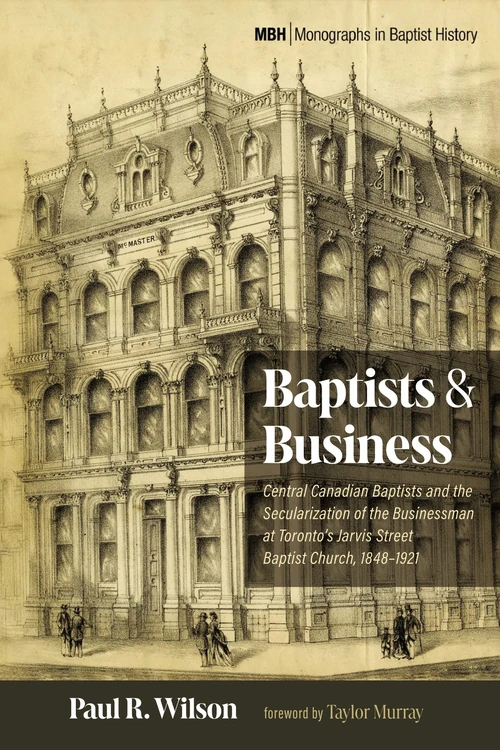
Baptists and Business
Central Canadian Baptists and the Secularization of the Businessman at Toronto’s Jarvis Street Baptist Church, 1848–1921
- History & Biography
- Publisher: Pickwick Publications (Wipf and Stock)
- Published: 2025
FritzSearch.com earns a commission on purchases made through Bookshop.org links.
Publisher's Description
This study of Baptist businessmen from Jarvis Street Baptist Church in Toronto breaks new ground. The challenges to faith exerted by the arrival of a new materialistic social ethic and a business-dominated culture in the last half of the nineteenth and early twentieth centuries has received little attention from Canadian historians. Instead, historians have primarily focused on religious leaders and intellectual challenges to faith. This study examines the sociocultural challenges that confronted one group of central Canadian Baptist businessmen from 1848 to 1921. Essentially, the findings offered here are used to sustain the argument that the rise of business and consumerism helped to secularize the beliefs, values, and practices of Baptist businessmen. Furthermore, the effects of secularization were profound on both the personal and church community levels.
Endorsements (5)
Foreword
“Using the business class at Jarvis Street Baptist Church as a case study, Paul R. Wilson presents an interesting look into the changes in (and challenges to) Baptist spirituality that occurred in Ontario around the turn of the twentieth century, the effects of which were both significant and long-lasting. This study is meticulously researched and compellingly argued. It is a must-read for those interested in Baptist history in Canada.”
“There is little doubt in my mind that this meticulous study of the inner life of Toronto’s Jarvis Street Baptist Church, one of the most famous Baptist congregations in Canada, is of utterly vital importance in understanding the Canadian version of the Fundamentalist-Modernist controversy during the first three decades of the twentieth century. Dr. Wilson moves beyond the simplistic affirmation that this controversy was only about doctrine. Rather, as he ably shows from his minute study of the archives at Jarvis Street, this controversy also had roots in the larger sociocultural changes that were transpiring on the Canadian landscape during this era. Highly recommended!”
“In a case study of the fashionable Jarvis Street Baptist Church, Toronto, Paul Wilson demonstrates that members of its nineteenth-century business elite gradually discarded traditional spiritual priorities. The process culminated when in 1921 the church’s minister, the imperious T. T. Shields, divided his church by publicly denouncing the laxity of his own deacons. Sociocultural change, not just intellectual broadening, was responsible for secularization, a conclusion which undoubtedly applies to many other congregations across the evangelical world.”
“This essential book for our times offers a compelling exploration of the complex interplay between faith and finance. Through meticulous research and engaging writing, Paul Wilson skillfully navigates the intricate world of inner-church politics and business, shedding light on the challenges faced by everyday Christians in their relationship with God and material wealth during pivotal moments in Canadian history. Wilson illustrates how Canada’s economic growth influenced Christian communities, revealing how their choices shaped broader theological conversations in unexpected ways. With his signature depth of insight and clarity, Wilson invites readers to reflect on these important dynamics.”
“An exceedingly well-researched volume that sheds new light on the turn of the century changes that occurred in iconic Jarvis Street Baptist Church, Toronto. Paul Wilson argues that key businessmen in the church were influenced by powerful social and religious forces to reimagine Christian piety as well as social standing among the affluent business class in Toronto. Wilson also argues that such a trajectory was a secularizing one that eventually led to conflict with concerned fundamentalists at Jarvis Street.”
See something wrong on this page? Report a problem