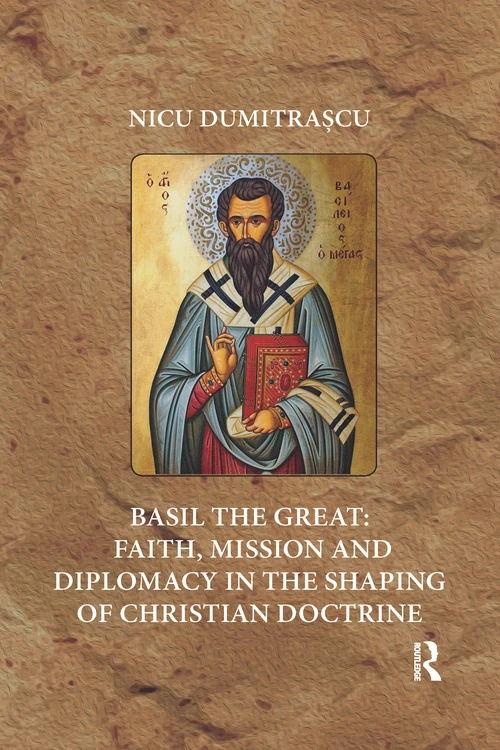
Basil the Great
Faith, Mission and Diplomacy in the Shaping of Christian Doctrine
- History & Biography
- Publisher: Routledge
- Published: 2020
FritzSearch.com earns a commission on purchases made through Bookshop.org links.
Publisher's Description
Regarded as one of the three hierarchs or pillars of orthodoxy along with Gregory of Nazianzus and John Chrysostom, Basil is a key figure in the formative process of Christianity in the fourth century. While his role in establishing Trinitarian terminology, as well as his function in shaping monasticism, his social thought and even his contribution to the evolution of liturgical forms have been the focus of research for many years, there are few studies which centre on his political thought. Basil played a major role in the political and religious life between Cappadocia and Armenia and was a key figure in the tumultuous relationship between Church and State in Late Antiquity. He was a great religious leader and a gifted diplomat, and developed a’special relationship’ with Emperor Valens and other high imperial officials.
Endorsements (4)
“Fr. Dumitrascu succeeds in his book to perceive the truth behind the phenomena and the mere estimation. This truth is consisted in the transformed mind of a saint, which depending upon the variety of his personal gifts, gives him a clear and whollistic spiritual vision and enables him to act accordingly. The author dignifies the unique spiritual beauty and power of the Bishop Basil of Caesarea and the ways these were unfolded in his life and action.”
“Fr. Dumitrascu examines an aspect of Basil's life that is less well known yet of great interest: his involvement in missionary work, and more especially his relations with Armenia. Basil is seen here not only as an eminent theologian but as a bridge-builder and diplomat, as a church leader of firm principles but also of moderation, strict yet at the same time gentle.”
“Dumitrascu succeeds here in delving into two relevant facets of Basil’s political activities. First, his strategy towards a hostile imperial power through his letters targeted to important officials of the court. Second, the author analyzes in detail Basil’s mission in Armenia in 372-373 on behalf of emperor Valens by putting it in relation with Catholicos Nerses own missions. As an unexpected consequence from Basil’s powerful confrontation with the emperor, that mission did not bring all the expected fruits though.”
“St. Basil of Caesarea is not known well enough in the West except for his influence on the Orthodox liturgy, as the father of Greek monasticism and as a close friend of Gregory of Nazianzus. In his amazing book Professor Dumitrascu sheds a welcome new light on other sides of Basil’s influence, for instance in Armenia, and especially in definitions of theology after Arius.”
See something wrong on this page? Report a problem