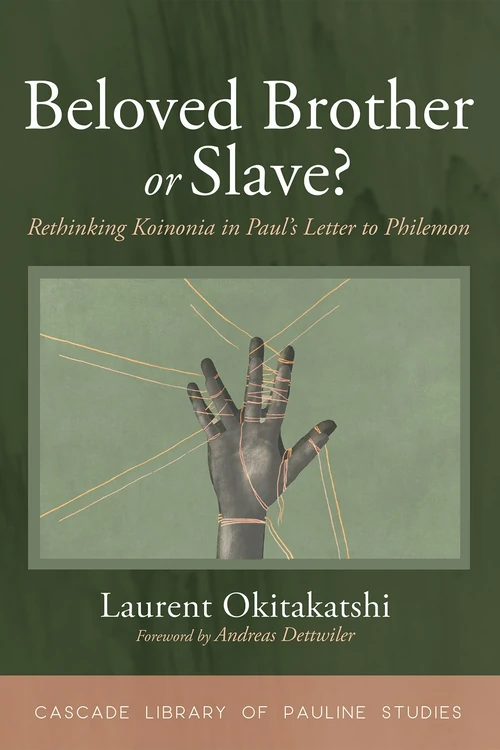
Beloved Brother or Slave?
Rethinking Koinonia in Paul’s Letter to Philemon
- Biblical Studies & Commentaries
- Publisher: Cascade Books (Wipf and Stock)
- Published: 2025
FritzSearch.com earns a commission on purchases made through Bookshop.org links.
Publisher's Description
Addressing Philemon as well as the church that meets in Philemon's house, Paul makes this prayer: "I pray that the koinonia of your faith may become effective when you realize all the good that we may do for Christ" (vv. 4-6). What was Paul's intention in revealing the content of his prayer for Philemon in a letter he knew would be read publicly? Why was Philemon's koinonia of faith both a matter of praise and an object of concern for Paul? The text does not answer these questions until ten verses later. In verse 16, one finds this radical and earth-shaking request, namely that Philemon receive Onesimus no longer as a slave but more than a slave, a beloved brother in the flesh and in the Lord (v. 16). This book stems from the realization that the word "brother" in verse 16 not only explains why Philemon's koinonia of faith was ineffective (v. 6) but also strengthens my claim that a call to an ethic of koinonia is the central message of the letter.
Endorsements (3)
“Drawing on narratology, spatial-syntax theory, and Roman social history, Beloved Brother or Slave? offers not only a critical reading of Paul, but also a profound, deeply humane, and novel understanding of the subjective experience of slavery in the Roman world. It will be valuable for scholars of early Christianity and Roman history alike.”
“Dr. Okitakatshi presents Paul as both narrating space and spatializing narrative, creating an alternate world where Jesus is Lord, allowing believers to experience true koinonia as siblings. Drawing from his social context in the Democratic Republic of Congo, he analyzes slavery as a power dynamic in which the powerful strip the powerless of their dignity through violence and exploitation. He envisions the possibility of building a better Congo by emulating Onesimus. Instead of feeling hopeless, individuals can aspire to become their best selves and embrace a glorious and dignified destiny. While interpreters rarely give voice to Onesimus, a marginalized figure with whom many enslaved individuals identify, Okitakatshi does.”
See something wrong on this page? Report a problem