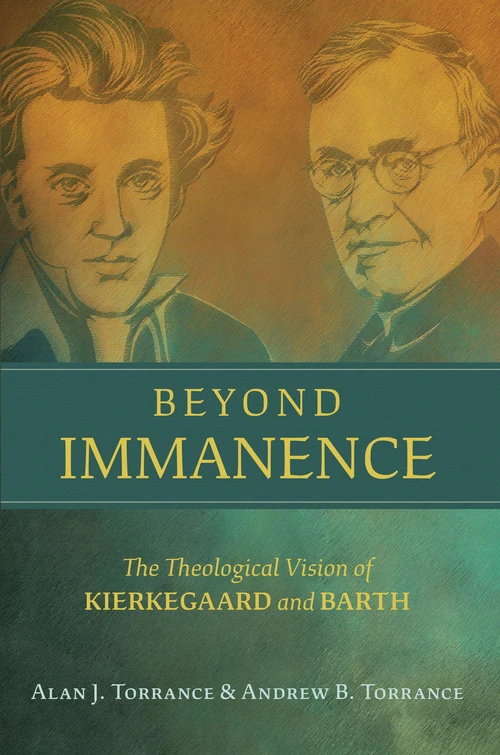
Beyond Immanence
The Theological Vision of Kierkegaard and Barth
- Theology
- Publisher: Eerdmans
- Published: 2023
FritzSearch.com earns a commission on purchases made through Bookshop.org links.
Publisher's Description
Church Times “As we traverse from the 19th and 20th centuries into the 21st, this important study reminds us that these voices challenging the myopia of immanence with the prospect of transcendence remain no less applicable to our plight now than they were then.” Christianity Today Book Awards - Academic Theology Finalist (2024) Critical insights into Kierkegaard’s influence on Barth’s theology. Karl Barth was often critical of Søren Kierkegaard’s ideas as he understood them. But close reading of the two corpora reveals that Barth owes a lot to the melancholy Dane. Both conceive of God as infinitely qualitatively different from humans, and both emphasize the shocking nearness of God in the incarnation. As public intellectuals, they used this theological vision to protect Christocentric faith from political manipulation and compromise. For Kierkegaard, this meant criticizing the state church; for Barth, this entailed resisting Nazism. Meticulously crafted by a father-son team of renowned systematic theologians, Beyond Immanence demonstrates that Kierkegaard and Barth share a theological trajectory—one that resists cynical manipulation of Christianity for political purposes in favor of uncompromising devotion to a God who is radically transcendent yet established kinship with humanity in time.
Endorsements (5)
“Alan and Torrance Andrew Torrance here remind us of the crucial importance of that theological trajectory that runs from Kierkegaard through Barth and on into our present. This study challenges our easy forgetfulness of the transcendence of God, the redeeming force of contingent revelation in Jesus Christ, and the radical conversion of heart and mind which must follow in their wake. By re-equipping contemporary theology with the lessons Barth and Kierkegaard together teach, the authors invite a specific reordering of the Christian mind with profound consequences for faith, life, theology, and ethics.”
“Even though Kierkegaard and Barth occupy center stage, this book speaks more to the present than the past. With the kind of creativity that comes only from deep learning, Alan Torrance and Andrew Torrance usher these two great modern thinkers into the fray of contemporary biblical studies, theology, and philosophy. The result is a powerful intervention in these disciplines, one ripe with possibilities for new dialogues within and among these disciplines.”
“Those who do not know the history of theology are doomed to repeat it. Alan Torrance and Andrew Torrance make good on this adage, showing that the same religious, cultural, and philosophical currents of immanentism that Kierkegaard and Barth each confronted in their own time and context continue to bedevil contemporary theology. Accordingly, what could have been simply a competent comparative historical study (which it is) here takes on additional urgency, for the temptation to let culture shape Christian theology and church practice remains strong. Beyond Immanence is a timely reminder that Barth and Kierkegaard were not geniuses, but apostles: people who know the transcendent God only because of what they have been told about Jesus Christ, the space-time incarnation of the Word of God.”
“Beyond the direct reception of Kierkegaard by Barth, which has its problematic side, Alan Torrance and Andrew Torrance show here with compelling precision how these two giants of the Christian tradition share certain fundamental insights into the nature of Christian truth—what they call the ‘Kierkegaard-Barth trajectory.’ As the exposition continues, however, we learn that they themselves stand within this trajectory. Indeed, as the book unfolds, step by step, Kierkegaard’s and Barth’s shared theological epistemology is both clarified and articulated. The result is nothing less than a major theological statement, which resonates with significance for adjacent philosophical, cultural, and political realms. But then what else would we expect when two of the finest theological minds of our generation explore two of the greatest theological minds of all time?”
“What has Barth to do with Kierkegaard? Many significant things, according to Torrance and Torrance. They identify Kierkegaard’s influence on Barth in the areas of philosophy and theology, with culturally defined religion being a shared target of criticism. They rightly focus on the importance to both Kierkegaard and Barth of interpreting divine self-disclosure on its own terms and in its own light, including in the light of the divine incarnation in Jesus Christ. For anyone concerned with the relation between Kierkegaard and Barth, this is the book.”
See something wrong on this page? Report a problem