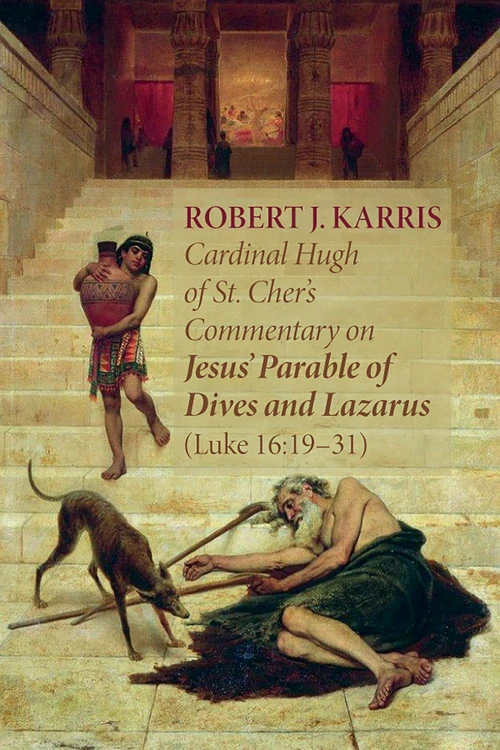
Cardinal Hugh of St. Cher’s Commentary on Jesus’ Parable of Dives and Lazarus (Luke 16:19–31)
- Biblical Studies & Commentaries
- Publisher: Pickwick Publications (Wipf and Stock)
- Published: 2021
FritzSearch.com earns a commission on purchases made through Bookshop.org links.
Publisher's Description
Cardinal Hugh of St. Cher was a water walker. He was learned in both law and theology. His leadership skills were so outstanding that he quickly became a major superior in his Dominican Order. Having gotten word of Hugh's talents, the pope made him a cardinal. The famed artist Fra Angelico placed Hugh in a crucifixion scene with the words "biblical interpreter" above his head. These words beautifully sum up what he was to generation after generation of biblical scholars and preachers till the sixteenth century. The Franciscan Cardinal St. Bonaventure (d. 1274) generously copied from Hugh's Commentary on Luke without attribution. So did the Dominican Bishop St. Albert the Great (d. 1280). Producers of homily aids in the thirteenth and fourteenth centuries filled their pages with nuggets from Hugh. What will you like about Hugh? First, he's not in an ivory tower. He calls out his fellow prelates for being more interested in gold than in sharing God's mercy with sinners and the poor. Second, he knows how to preach the text, breaking it down into memorable soundbites. Third, he knows and creatively adapts the Scriptures and tradition. Reading his commentary on Dives and Lazarus will not only activate your mind and warm your heart. Would you be surprised if it also were to trouble your conscience?
Endorsements (5)
“Karris . . . provides us with a rare treat in this gem of a book that brings to life a thirteenth-century interpretation of the parable of the rich man and Lazarus. Karris shows that the work of Hugh of St. Cher is still as relevant today as in his own time. The parable, as Hugh interprets it, continues to disturb Christians of means and move them to action on behalf of persons who are made poor today.”
“Modern biblical scholars can sometimes forget that their patristic and medieval predecessors could also analyze the Scriptures with intelligence and grace. . . . A fresh translation, an illumination of the historical context, and an annotated presentation of Cardinal Hugh’s provocative interpretation of the parable make this work a delight.”
“Today the name of Cardinal Hugh of St. Cher may not be well known—even among biblical scholars—but it should be. Readers will owe a great debt to the work of Robert Karris, who has so deftly shown the perspicacity and breadth of intellect of this medieval Dominican friar. Karris writes that he became enthralled with the work Hugh of St. Cher. Having read this study of Hugh’s commentary on the parable of Lazarus and the rich man, I now not only understand the thrall that Fr. Karris confesses, but I share it.”
“After years of studying the influence of Cardinal Hugh of St. Cher’s influence on Saint Bonaventure, Karris’s turn to studying the influential source of the Seraphic Doctor’s exegetical inspiration is most welcome. This long-anticipated study is a crucial tool for those seeking to understand the depth and breadth of mendicant scriptural exegesis in thirteenth-century Paris.”
“Composed in the vibrant spiritual and cultural context of the Dominican convent of Paris, the Postilla circulating under the name of Hugh of St. Cher is one of the most surprising and influential medieval commentaries to the Bible. By translating and analyzing its interpretation of the story of Lazarus and the rich man, Karris offers an excellent entry point into this rich world, ideal for anyone interested in the thirteenth-century pastoral revolution and in the reception history of the Bible.”
See something wrong on this page? Report a problem