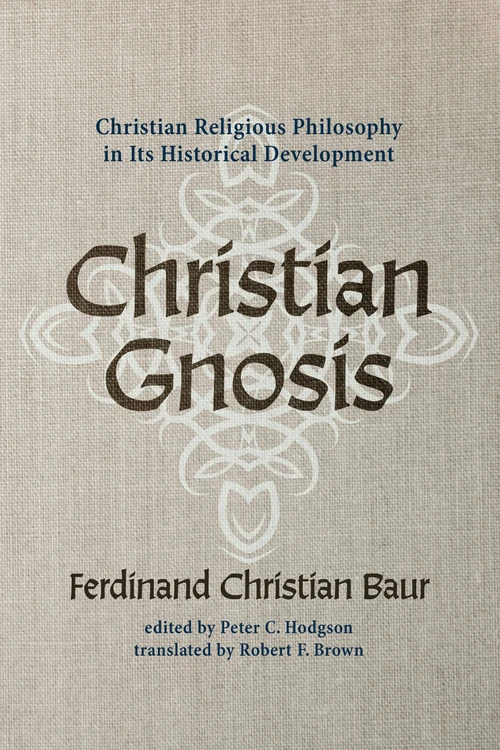
Christian Gnosis
Christian Religious Philosophy in Its Historical Development
- Theology
- Philosophy
- Publisher: Cascade Books (Wipf and Stock)
- Published: 2020
FritzSearch.com earns a commission on purchases made through Bookshop.org links.
Publisher's Description
Baur published Die christliche Gnosis in 1835. It was his first great religio-historical study and the most important book on Gnosticism published in the nineteenth century. It is now recognized as having a pivotal status in Baur studies. In it Baur offers a unique thesis about a link between ancient and modern religious philosophy. Gnosis is a type of religious philosophy that contains ideas about the relationship between God, world, and human beings, as expressed in concrete religious traditions and practices. As such, it makes an important contribution to Christian theology. In the first part, Baur develops a concept of gnosis in dialogue with his predecessors and contemporaries. He classifies the gnostic systems in terms of how they conceive the relationship of Christianity to Judaism and paganism, and then describes them in detail (Valentinus, Ophites, Bardesanes, Saturninus, Basilides, Marcion, Pseudo-Clementines). Following transitional sections on the criticism of and reaction to gnosis in church history, the book ends with modern religious philosophy (Boehme, Schelling, Schleiermacher, and Hegel--Baur's first discussion of these major thinkers). This book was written over a hundred years before the manuscript discovery at Nag Hammadi, which awakened a lively interest in Gnosticism that continues to the present day.
Endorsements (2)
“That Baur’s speculative masterpiece, Die christliche Gnosis (1835), has not been translated into English before now has always struck me as a scandal. Fortunately, it is a scandal no more, and, arguably, it was worth the wait to have the eminent theologian and master scholar of both Hegel and Baur be the translator. Hodgson’s translation of this difficult and sometimes meandering text is impeccable. But what is even more impressive is that in his translation we capture some of the excitement of Baur’s critical retrieval of ancient forms of thought laid aside in the emergence of the Catholic Church that has shaped—whether consciously or unconsciously—a form of modern Protestantism that moves decisively beyond sola scriptura.”
“In Christian Gnosis, Ferdinand Christian Baur set forth with vigor and surprising clarity what he referred to as the ‘internal coherence’ of the gnostic system, from antiquity to the thought of his older contemporaries, Schelling, Schleiermacher, and Hegel. In this beautiful annotated translation, Peter Hodgson and Robert Brown make this important work accessible to the anglophone world at last, enabling a new generation of readers to wrestle with Baur’s provocative synthesis of a perennial theme.”
See something wrong on this page? Report a problem