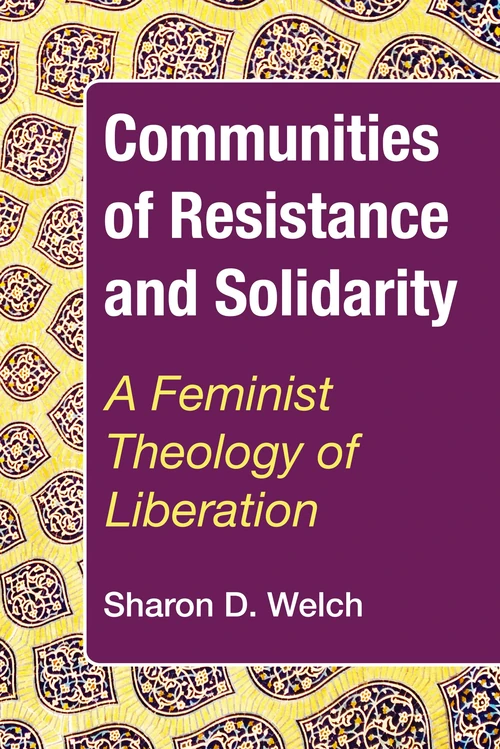
Communities of Resistance and Solidarity
A Feminist Theology of Liberation
- Theology
- Publisher: Wipf and Stock
- Published: 2017
FritzSearch.com earns a commission on purchases made through Bookshop.org links.
Publisher's Description
"Sharon D. Welch boldly continues to be a crucial liberative voice who refuses to embrace simplistic truth claims or gloss over Christian-based violence which leads many to hopelessness. She critically analyzes what it means to be a scholar-activist, forcing the rest of us who use such a label to question what our faith and actions rests upon. Cognizant of her privileges, she nevertheless focuses on the particular and moves forward in constructing a liberationist response attuned to a critical thinking paradigm which remains rooted in praxis. Maybe this theological shift might just save liberal Christianity? Regardless if it does, such a move positions Welch, and those who take her work seriously, to authentically stand in solidarity with different marginalized communities in resistance to social structures responsible for so much of today's global oppression." --Miguel De La Torre
Endorsements (5)
“How many times have we asked what would be an appropriate North American equivalent to the base communities and the liberation theology of Latin America? Now in Sharon Welch's fluent but solid book we have an answer. Drawing on a wide variety of philosophical and theological sources and viewing the whole from a critical feminist perspective, Welch suggests how subjugated forms of knowledge can be recuperated as human communities learn to support each other in resisting our socio-cultural death wish. A passionate and poetic book, which strikes a new chord in theology both in style and in substance.”
“In this book Sharon Welch contributes to a vital conversation, namely, in what sense feminist liberation theologians (for that matter, all honest theologians) must acknowledge both the relativist insights of their truth-claims and the ethically normative value of their work. This is a critical dialectic and Welch's theology helps sharpen it.”
“Sharon Welch offers here not simply a feminist theology of liberation but a new way of doing theology as such. She brings together the resources of Christian faith, the creativity and passions of personal experience, and finely honed instruments of analysis found in Michel Foucault and Ernst Bloch. The results are exciting: 'dangerous memory,’ 'genealogies of resistance,' 'poetics of revolution.' It would be difficult to read this work and continue to think in the usual ways about men and women, faith, power, theology, in fact, about anything.”
“Sharon Welch is the quintessential scholar/activist, one who has never let her devotion to the academy and signal accomplishments there preclude a profound commitment to changing the 'real world' in which we live.”
“I think of Welch as the best kind of activist/academic, and consider her a role model. Her recent focus on alternatives to the binary ways of thinking about morality and war/peace initiatives, and her honest explorations of the amoral character of religion are truly exciting. That she refuses to romanticize religious traditions—even as she attends with utter seriousness to the possibilities for liberative and humane possibilities for global life—gives Welch a kind of realistic wisdom unusual for an academic.”
See something wrong on this page? Report a problem