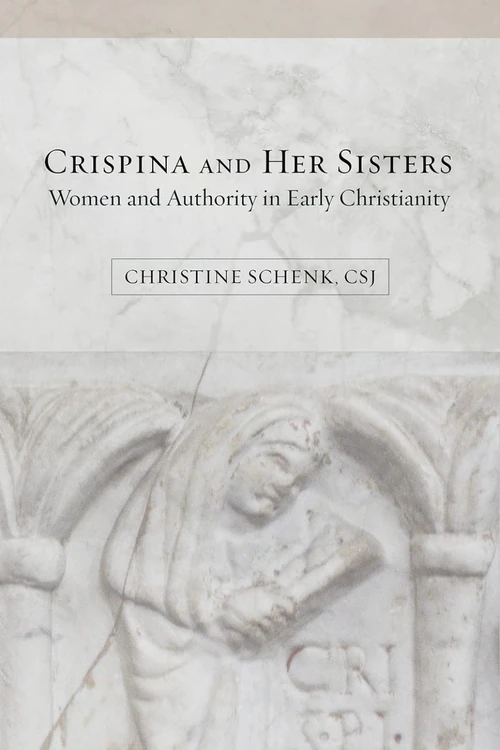
Crispina and Her Sisters
Women and Authority in Early Christianity
- History & Biography
- Publisher: Fortress Press (Augsburg Fortress)
- Published: 2017
FritzSearch.com earns a commission on purchases made through Bookshop.org links.
Publisher's Description
Discovering reliable information about women in early Christianity is a challenging enterprise. Most people have never heard of Bitalia, Veneranda, Crispina, Petronella, Leta, Sofia the Deacon, and many others even though their catacomb and tomb art suggests their authority was influential and valued by early Christian communities. This book explores visual imagery found on burial artifacts of prominent early Christian women. It carefully situates the tomb art within the cultural context of customary Roman commemorations of the dead. Recent scholarship about Roman portrait sarcophagi and the interpretation of early Christian art is also given significant attention. An in-depth review of women’s history in the first four centuries of Christianity provides important context. A fascinating picture emerges of women’s authority in the early church, a picture either not available or sadly distorted in the written history. It is often said “a picture is worth a thousand words.” The portrait tombs of fourth-century Christian women suggest that they viewed themselves and/or their loved ones viewed them as persons of authority with religious influence.
Endorsements (6)
“Chris Schenk has tackled a neglected area of investigation about the learning and leadership of early Christian women, drawing on material evidence that has often been overlooked. This is an important contribution toward better appreciation of women’s role in the patronage and networking that advanced the spread of Christianity in its early centuries.”
“Crispina and Her Sisters is at its best when it balances visual and textual representations of biblical events in determining women’s authority in Early Christianity. This book provides a wealth of visual resources for future scholars of Religious Studies but deserves to be read by anyone interested in the cultural history of women in antiquity.”
“Sr. Schenk’s meticulous study of sarcophagi from the early years of Christianity will change not only the understanding of Christian women from this period, but indeed the understanding of early Christianity itself. While literary sources about Christian women from this period remain scarce and ambivalent on the role of women, sarcophagi show us how Christian women (and those close to them) imaged themselves as leaders in the Church on their eternal monuments. Anyone interested in early Christianity must read this book. It is the most important analysis of new evidence in decades.”
“After introducing readers to modern scholarship on women’s roles in early Christianity, Schenk turns to her main theme: that a statistical study of catacomb commemorations of Christian women and of female portraits on Christian sarcophagi suggests that they and their relatives chose representations that conveyed the notion of women as authoritative figures. She then seeks to integrate this evidence with that of literary texts about notable Christian women of late antiquity. Schenk concludes with a series of charts and tables that sum up her findings. A helpful addition to the now large body of work on women in early Christianity.”
“History is often just that—history. Chris Schenk’s Crispina and Her Sisters is fascinating history but it is also much more than that. It is two stories in one, both of which purport to explain the role and place of women in society. One story lies in the words of the time in which they were written; the other in the sculpturing of coffins in early cemeteries of the same era. The interesting thing is that the stories not only often contradict one another but they explain much of what we see among us now. Which is why this book is so important to both women and men of our own time. The book is not only timely, it is highly accessible reading to all ages and types of readers. More than that, it is a book that should read by all types of readers if we ever want to understand our own age as well as those before us.”
“Tremendously informative! This book opens a new window on the religious influence of early Christian women by decoding over 2,000 artistic remains: frescoes, tomb inscriptions, carved sarcophagi, and the like. As in a detective story, each chapter supplies multiple material clues about “whodunit,” enabling readers to confidently write women back into the history from which they have been erased. The author’s thesis about women’s authority is wonderfully illuminated by photographs, tables, and appendices. What a gift, to have the witness of these women of great faith restored to the memory of the church.”
See something wrong on this page? Report a problem