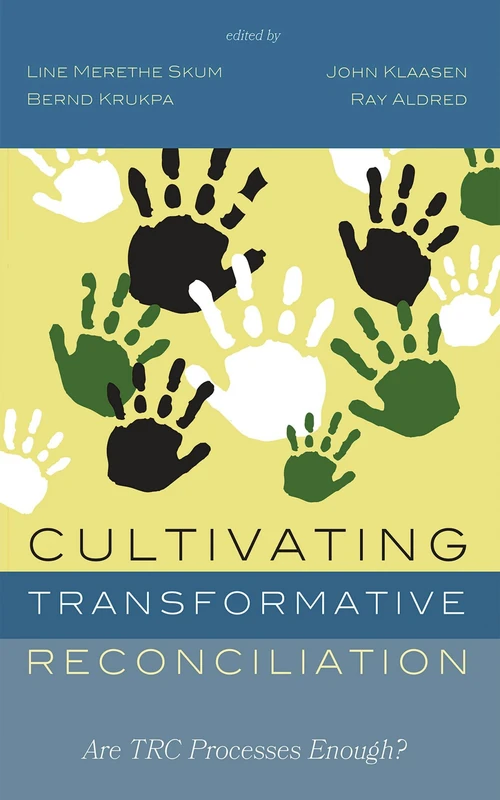
Cultivating Transformative Reconciliation
Are TRC Processes Enough?
- Ethics, Culture & Social Issues
- Publisher: Pickwick Publications (Wipf and Stock)
- Published: 2024
FritzSearch.com earns a commission on purchases made through Bookshop.org links.
Publisher's Description
Are Truth and Reconciliation Commission processes enough to achieve reconciliation? This volume discusses issues that arise once the task of reconciliation emanates from the limited scope of a specific Truth and Reconciliation Commission and into the larger society and political system that originated it. Scholars spanning several research fields, from law to history to theology, discuss how transformative reconciliation can be cultivated in a society, using decolonization and other perspectives, along three lines: by specifying transformative issues and processes in law and politics, by criticizing historical perspectives on the past and its concepts as deliberations of the status quo, and by instilling the inherent dynamics of truth and reconciliation processes as permanent features within broader society. The volume embarks on an investigation of the Norwegianization policy, a historical framework that brought injustices upon minority groups, such as the Sami and Kvens (Norwegian Finns) in Norway, and parallel groups in Sweden and Finland. It extends its exploration to analogous unjust policies in South Africa, Canada, and various other contexts. Within the complex web of cultural, social, political, and economic struggles stemming from colonial policies, the roles of religion, politics, research institutions, and civil society are critically examined.
Endorsements (4)
“The book reveals that reconciliation cannot materialize as long as the vulnerable, marginalized, and Indigenous nations of this world remain captive, anonymous, and subject to pseudo colonial-hegemonic groups. The authors envision, through concrete transformational praxes, to unearth historical injustices by amplifying the values of marginalized Indigenous communities and fostering societal change. May it be that the vision of Nelson Rolihlahla Mandela materializes in our age: ‘Never, never and never again shall it be that this beautiful land will again experience the oppression of one by another and suffer the indignity of being the skunk of the world.”
“In its investigation of the connection between reconciliation in practice and the role of TRCs, this book presents us with comparative research that is driven by leading scholars from three different continents presenting both the global North and South. It makes a vital contribution to the discourse around truth and reconciliation commissions and whether or how their processes are successful in cultivating communities for visible transformation.”
“The expanding literature around the contested legacies of truth and reconciliation commissions necessitates multidimensionality. Contributions in this volume move between the domains of politics, law, philosophy, sociology, and theology, filling this lacuna through a South African–Nordic exchange, where restoration and transformation remain inseparable from the examination of colonial heritages. At once political and religious, TRCs here are subject to their inherent limitations but also creatively interpreted into new horizons of possibility. This is a significant collaborative effort and rich collection.”
“This book is an important contribution to what is a new but important and growing field in the Nordic countries—truth, reconciliation, and the implication for the relationships between peoples of the north. The inclusion of several minority groups alongside the Indigenous Sámi makes the book one of special interest.”
See something wrong on this page? Report a problem