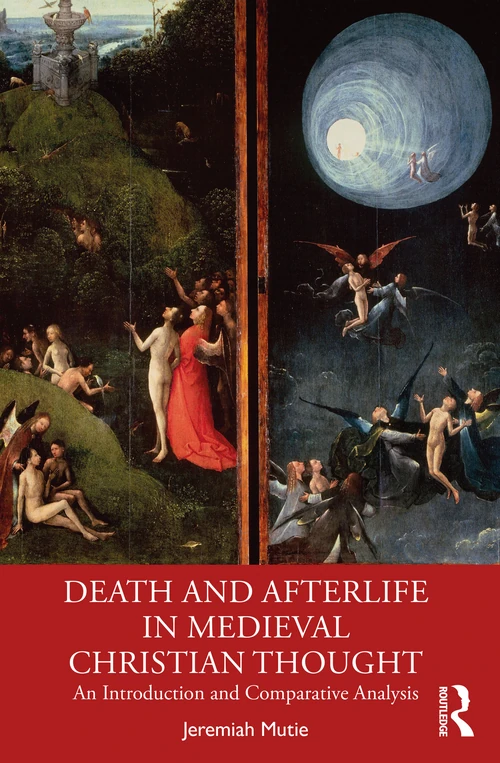
Death and Afterlife in Medieval Christian Thought
An Introduction and Comparative Analysis
- History & Biography
- Publisher: Routledge
- Published: 2025
FritzSearch.com earns a commission on purchases made through Bookshop.org links.
Publisher's Description
Death and Afterlife in Medieval Christian Thought explores how medieval Christians conceived the changing ideas of death and what happens thereafter to both the material and immaterial aspects of a person. Where much scholarship has addressed this topic from a Western point of view, this book asks how these ideas emerged and progressed over this long period of time in both Western and Eastern medieval Christianities. The work examines the two leading motifs of death and the afterlife in Western medieval Christian thought: Purgatory and the cult of the saints. It then proceeds to shift the spotlight to conceptions of death in Eastern Christianity, all the while maintaining a comparative approach. This book not only delves into the theoretical, but draws on archaeological evidence, such as artefacts, to provide a broader view of the evidence. Ultimately, it finds that medieval Christians continued the process that started in Christianity’s earliest days of borrowing and modifying existing ideas of death and the afterlife in order to produce a distinctive and sophisticated Christian set of beliefs. As an accessible introduction, this book stands as a valuable resource to students, scholars and all readers interested in early medieval Christianity, the history of ideas, and the history of death.
Endorsements (3)
“One of the greatest areas to explore within Christian thought and practice relates to the interaction between the physical (natural) and the metaphysical (supernatural), to what extent these properties are impacted through human activities, and what consequences may exist between this life and the life to come. In this comprehensive and well-documented work Mutie recognizes the need to explore the development of beliefs regarding these connections and provides important scholarly analysis of the historical, cultural, and theological perspectives of resulting ecclesiastical practice. I greatly appreciate Mutie’s commitment to effectively wade into these deep waters that shape religious conclusions and practices of lasting personal concern.”
“In times when death seemed much nearer to daily life than today, medieval Christianity sought to answer what happens in moments before death, in death itself, and then in the afterlife. Building on his previous work Death in Second-Century Thought (2015), Dr. Jeremiah Mutie continues his tour-de-force of scholarship evaluating classical Latin with Orthodox thanatologies. Questions of theological method, sources, and doctrinal and practical development come to the fore. In so doing, Mutie informs today’s Christian understanding of death as to what might be pared away and what has enduring value.”
“Many of humanity’s fundamental questions revolve around death. This book is an ambitious introduction to how Christians answered those fundamental questions on death and the afterlife from the early church to the Reformation drawing on evidence from western and eastern forms of Christianity. These answers demonstrate presuppositions about some of the key beliefs in Christianity that continue to influence Christians today. Anybody who wants to understand the origins of some fundamental differences between Eastern Orthodoxy, Roman Catholicism, and Protestantism should read this book.”
See something wrong on this page? Report a problem