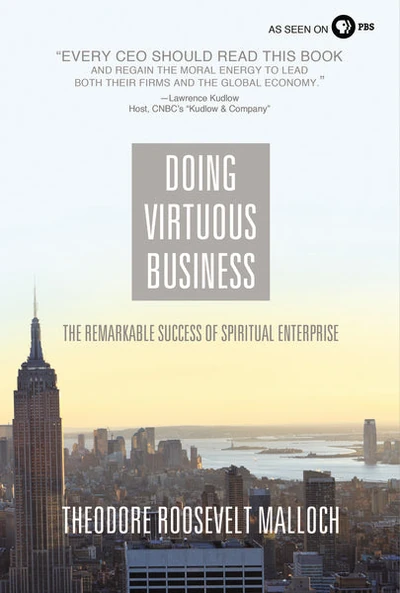
Doing Virtuous Business
The Remarkable Success of Spiritual Enterprise
- Work, Money & Leadership
- Publisher: W Publishing Group (Thomas Nelson)
- Published: 2011
FritzSearch.com earns a commission on purchases made through Bookshop.org links.
Publisher's Description
Can the concept of "Spiritual Capital" actually ensure a company's success? Critics of capitalism view big businesses as insatiable masters of the universe with little regard for the public. They label those who create wealth as greedy, malicious, and unscrupulous. Doing Virtuous Business answers these charges head-on. In this insightful and original book, Theodore Roosevelt Malloch presents the bold idea that the creation of wealth by virtuous means is the most important thing that can be done for society. Doing Virtuous Business explains the true purpose of business and illuminates the connection between a free economy and religious liberty. Drawing from the notion of "social capital," which has been developed by generations of scholars, Malloch adds the concept of "spiritual capital" as a foundation for social progress and also a necessity for responsible and successful enterprise. He details the virtues that sustain a business and a free market—virtues that build up a network of trust, which is critical to the global economy. Malloch reveals that a company's soul determines its "spiritual capital," an equally imperative foundation to success. From Wal-Mart to IBM, Malloch demonstrates how companies that operate on ethical models informed by spiritual traditions have outperformed their competitors. This book is a welcome moral defense of free enterprise and a sensible guide for achieving the ideal of virtuous business. Besides making the world a better place, Malloch argues, virtuous enterprise makes companies far more successful and profitable than they otherwise would be. He presents case studies of virtuous business in the Judeo-Christian tradition as well as statistical analysis demonstrating how companies that operate on ethical models have outperformed their competitors over the long run.
Endorsements (14)
“Every CEO should read this book and regain the moral energy to lead both their firms and the global economy.”
“Not since Adam Smith himself have we witnessed so forceful a treatment on the linkage between the economy and moral reasoning as we find in Malloch’s Doing Virtuous Business.”
“This book is a classic. Ted Malloch does a masterful job in helping the reader to understand the important role of faith in the leadership and operation of a successful business and also the necessity of ‘spiritual capital’ for a healthy market.”
“Business leaders have been deeply impressed by the research of scholars on the role ‘social capital’ plays in our personal and professional lives. In this timely book, Theodore Malloch argues that ‘spiritual capital’ does an equally important service: it supplies businesses with people who have strong personal convictions, moral scruples, virtuous character traits, and spiritual discipline—all of which contribute to business success. Malloch shows how spiritual capital encourages compassion, forgiveness, perseverance, patience, courage, humility, and self-control. This highly informative book provides a useful service because I do not think there is another book quite like Doing Virtuous Business.”
“The owl of wisdom takes flight in this book. Malloch provides an entire framework for the values and virtues of a good corporation.”
“Self-control, corporate discipline, and virtue are the conditions sine qua non for capitalism. This book offers detailed examples from which we all can learn.”
“I have never seen a better outline of the social and spiritual factors responsible for stewardship of the modern political economy and its main agent, the corporation.”
Dr. Luder Whitlock
“If corporations have souls or spirited characters, on the foundations of this book, they can now find spiritual grounding.”
Dr. David W. Miller
“Yes, capitalists can be as greedy as anyone else. But as Ted Malloch is happy to explain, the best entrepreneurs are here to serve. Business may not be the same as charitable social service, but at its best it is like social service in that it intends to serve a legitimate need. And, as Malloch reminds us, God did not retire from the universe business to go into ministry. He is still in the universe business.”
“Dr. Malloch’s book examines types of capital that heretofore have not received much attention. It raises issues other educators and businesspersons would do well to address. A worthwhile read.”
“Capitalism is under attack from all sides. The environmentalists blame capitalism for global warming; the defenders of the Third World blame capitalism for unfair trading and the destruction of local economies; the peace activists blame capitalism for America’s ventures in the Middle East and Afghanistan, believing that without capitalism these interventions in distant countries would not be necessary to our economy. And politicians and many small investors blame capitalism for the financial collapse that we have recently experienced: Wall Street collapsed, they argue, because capitalism has an inherent tendency to spin out of control. The issue of health care has brought the controversy to a new head, as the president seeks to create the kind of welfare state that has appealed in the past to socialists. But the critics are pointing their fingers at the wrong thing. It is not capitalism that is at fault, but the wrong sort of capitalism—free enterprise divorced from its moral and spiritual base. Doing Virtuous Business: The Remarkable Success of Spiritual Enterprise takes up the challenge, showing incontrovertibly that free enterprise is not merely compatible with moral and spiritual integrity but is a piece with them. By conducting business according to spiritual values, we both fulfill God’s commandments and also enhance our own and others’ prosperity. The economic crisis that we are going through is not the fault of capitalism but the fault of enterprise conducted without due regard for the moral and spiritual discipline that makes free enterprise possible. In this extremely clear and carefully argued book, taking the reader through concrete and convincing examples, Theodore Roosevelt Malloch provides stunning proof that the free economy is a spiritual achievement and that material success is inseparable from moral and religious conviction.”
“The development of an awareness of human and Judeo-Christian values and the application of these values to life in corporate enterprises, in particular through the concepts of giving oneself and solidarity, are to encourage the growth and development of persons in their working environments. This is the great accomplishment of Doing Virtuous Business: The Remarkable Success of Spiritual Enterprise.”
“The manifest failure of economists and politicians to anticipate the recent financial crisis cannot be understood without considering the underlying failure to take into account the impact on individuals of the driving process of global capital. Obstacles to creating a better world will remain until people play a more significant role in the process of globalization. Malloch’s Doing Virtuous Business: The Remarkable Success of Spiritual Enterprise helps all of us find that better path. Without the virtues it extols, capitalism may die and wither away.”
“must possess before they go to market and compete with each other. These are the indispensable supports which preserve both market and competition from degeneration. Family, church, genuine communities, and tradition are their sources.”
See something wrong on this page? Report a problem