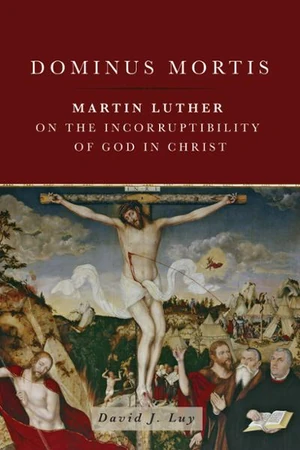
Dominus Mortis
Martin Luther on the Incorruptibility of God in Christ
- Theology
- Publisher: Fortress Press (Augsburg Fortress)
- Published: 2014
FritzSearch.com earns a commission on purchases made through Bookshop.org links.
Publisher's Description
Modern interpreters typically attach revolutionary significance to Luther’s Christology on account of its unprecedented endorsement of God’s ontological vulnerability. This passibilist reading of Luther’s theology has sourced a long channel of speculative theology and philosophy, from Hegel to Moltmann, which regards Luther as an ally against antique, philosophical assumptions, which are supposed to occlude the genuine immanence of God to history and experience. David J. Luy challenges this history of reception and rejects the interpretation of Luther’s Christology upon which it is founded. Dominus Mortis creates the conditions necessary for an alternative appropriation of Luther’s christological legacy. By re-specifying certain key aspects of Luther’s christological commitments, Luy provides a careful reassessment of how Luther’s theology can make a contribution within ongoing attempts to adequately conceptualize divine immanence. Luther is demonstrated as a theologian who creatively appropriates the patristic and medieval theological tradition and whose constructive enterprise is significant for the ways that it disrupts widely held assumptions about the doctrine of divine impassibility, the transcendence of God, dogmatic development, and the relationship of God to suffering.
Endorsements (2)
“Sometimes the best innovation consists in showing that no innovation is needed. David J. Luy demonstrates how Luther’s theology of the cross employs the resources of patristic and medieval theology. This careful study reminds all friends of Luther to not read our own favorite ideas into the thought of the Reformation.”
“This is an extremely important book. It directly challenges two related assumptions that inform much of contemporary theology, namely, that traditional Christology is inadequate because of its emphasis on divine impassibility, and that Martin Luther provides the necessary way forward by formulating a new Christology in which God truly suffers, thus allowing for a more satisfying account of God’s involvement in human history. David Luy presents a strong case for rejecting the theory of Luther’s divergence from traditional Christology and also argues that the reformer, rightly understood, supplies a more compelling account of divine immanence than those who emphasize his alleged novelty have appreciated. Dominus Mortis is a demanding, bold, and stimulating piece of scholarship whose argument has profound implications for the future course of both historical and constructive theology. An exceptional achievement!”
See something wrong on this page? Report a problem