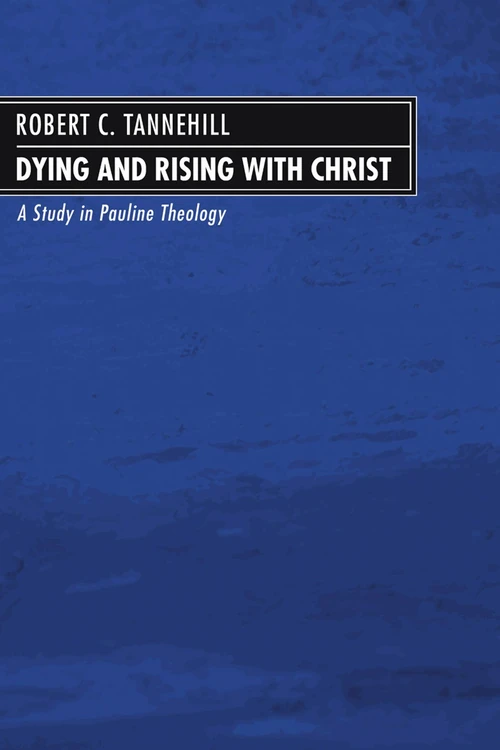
Dying and Rising with Christ
A Study in Pauline Theology
- Biblical Studies & Commentaries
- Publisher: Wipf and Stock
- Published: 2006
FritzSearch.com earns a commission on purchases made through Bookshop.org links.
Publisher's Description
In Part I Tannehill presents a thorough exegetical analysis of Rom 6, 7:1-6; Gal 2:19-20, 5:24-25, 6:14-15; II Cor 5:14-17; and of the baptismal passages in Colossians and Ephesians. . . . In Part II Tannehill discusses those text which employ the motif in the interpretation of the present Christian existence. In this context, the motif is related to ethical action, to suffering, and to 'transformation.' . . . The exegesis of the texts leads to two main observations. It is Paul's eschatology which provides the key to understanding the relation between dying with Christ as a past even and as a present experience of the Christian believer. Furthermore, 'Although rising with Christ is a necessary part of the motif of dying and rising with Christ, it is not the apect which gives this motif its importance for Paul. . . . It is when Paul wishes to bring out the participation of the believer in Christ's 'death' that this motif has a special function in his thought' (pp. 130f.). . . . I want to underline that the author has presented us with a piece of solid scholarship which must especially be appreciated because so little of this type of exegtical analysis of Pauline texts is available in the English language. --Hans Dieter Betz 'Journal of Biblical Literature'
Endorsements (1)
“In Part I Tannehill presents a thorough exegetical analysis of Rom 6, 7:1-6; Gal 2:19-20, 5:24-25, 6:14-15; II Cor 5:14-17; and of the baptismal passages in Colossians and Ephesians. . . . In Part II Tannehill discusses those text which employ the motif in the interpretation of the present Christian existence. In this context, the motif is related to ethical action, to suffering, and to 'transformation.' . . . "The exegesis of the texts leads to two main observations. It is Paul's eschatology which provides the key to understanding the relation between dying with Christ as a past even and as a present experience of the Christian believer. Furthermore, 'Although rising with Christ is a necessary part of the motif of dying and rising with Christ, it is not the apect which gives this motif its importance for Paul. . . . It is when Paul wishes to bring out the participation of the believer in Christ's 'death' that this motif has a special function in his thought' (pp. 130f.). ". . . I want to underline that the author has presented us with a piece of solid scholarship which must especially be appreciated because so little of this type of exegtical analysis of Pauline texts is available in the English language.”
See something wrong on this page? Report a problem