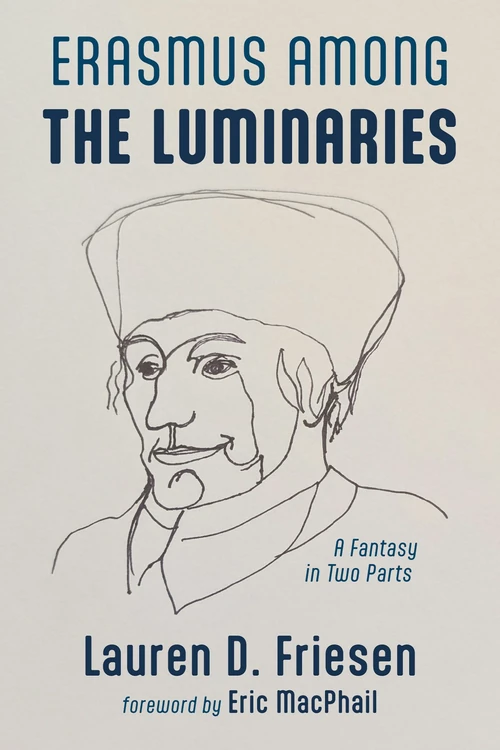
Erasmus Among the Luminaries
A Fantasy in Two Parts
- Fiction
- Publisher: Resource Publications (Wipf and Stock)
- Published: 2025
FritzSearch.com earns a commission on purchases made through Bookshop.org links.
Publisher's Description
Ever wake up and feel disoriented, not knowing the place or time? Erasmus finds himself in that situation and slowly discovers he is surrounded by noteworthy men and women from the pages of history. They are all focused on the question: What is good? Initially, their ideas vary greatly. Their serious dialogue is peppered with humor as they discover the common ground that unites them.
Endorsements (5)
“I love logic, the beauty and poetry of it, and that was one of the main reasons I enjoyed Erasmus Among the Luminaries. There’s a lightness to it because of the back and forth of the dialogue. Such big ideas carried along so lightly. Such deep ideas all hovering on the surface where they become entertaining. It could so easily have been something going off in all directions. The focus on the body in the middle was a stroke of genius in terms of staging. And all the time levels are deftly interwoven. A brilliant work of art.”
“A brilliant cross-examination of a cross-section of Luminaries who throw light and shade while playfully taking time out for tea.”
“If Socrates, Hrosvitha, Aquinas, and Gandhi are among your fantasy tea party guests, pull up a chair for Erasmus Among the Luminaries! Envisioning the afterlife as a sparkling debate among history’s great thinkers, Friesen invites us to ponder big questions of faith, goodness, and beauty with both depth and cheek.”
“Lauren Friesen mines a rich seam of intellectual history to deliver this gem of a conversation among world intellects, who gather in ‘A Room in the Great Beyond’ in hopes that the newly-arrived Dutch humanist Erasmus (1466–1535) can settle a controversy among them: ‘What is good?’ One part Waiting for Godot, one part No Exit, three parts philosophical fantasia, Friesen’s Erasmus should be required reading for every university survey of comparative thought in religion—which is how I’ll be employing it in the one I teach.”
See something wrong on this page? Report a problem