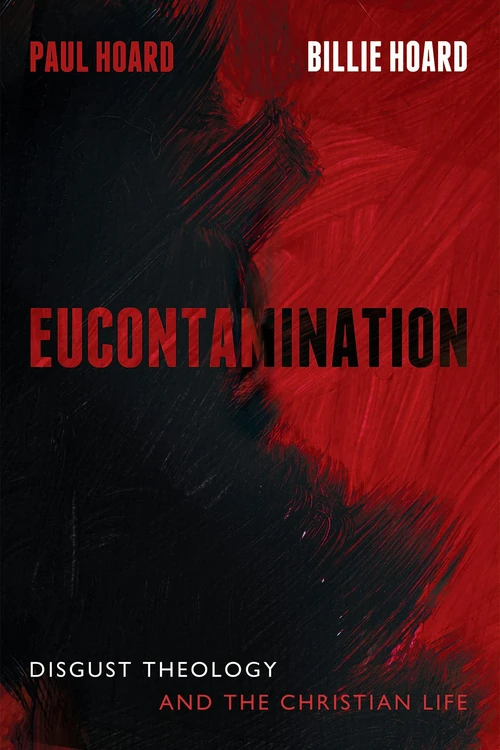
Eucontamination
Disgust Theology and the Christian Life
- Theology
- Publisher: Cascade Books (Wipf and Stock)
- Published: 2025
FritzSearch.com earns a commission on purchases made through Bookshop.org links.
Publisher's Description
For too long, Christianity has been distorted by an overapplied purity-disgust metaphor: fueling exclusion, reinforcing fear, and enabling Christian Nationalism. Eucontamination challenges this toxic framework, arguing that Jesus did not retreat from impurity but transformed it. This interdisciplinary work weaves together psychology, psychoanalysis, theology, and sociology to expose how disgust has shaped Christian witness--from theological education to church exclusion and social scapegoating. But there is a better way. The authors propose that Christ is not fragile in the face of sin but a "good infection," a force that spreads healing and redemption. Instead of protecting a brittle purity, true faith embraces eucontamination--a sanctifying engagement with the world, not a retreat from it. For Christians seeking a faith that resists exclusion and embraces radical love, Eucontamination offers a vision of transformation--one where Truth, Life, and the Way are not delicate things to be defended but powerful forces moving through and within us all.
Endorsements (13)
“I came across Billie and Paul’s work in a workshop at a queer Christian conference, and it pinged in my spirit as the exact way to describe what I had been experiencing in the Black church. I had been experiencing disgust, but I didn’t know what to call it—because it was so subtle and pervasive. We agreed on Blackness. We agreed on the same truth. So, the resistance I was feeling, I didn’t know how to name. Encountering their work on disgust and eucontamination was a revelation. It gave me language for what I had been feeling but couldn’t articulate. It became a crucial part of my own process of self-actualization and healing from the diseased ways I was taught to move through the world. And as I become more regulated, I’m seeing so much lived manifestation of their deep psychoanalytical, scientific, and theological work. I truly believe that we can infect the world with good. It’s working for me.”
“Drawing on their expertise, experience, and shared commitment to Christ’s church, Billie and Paul Hoard have written a book that truly embodies the Way of Jesus. They call followers of Jesus to leave behind a faith marred by disgust theology and embrace eucontamination (contamination for good) as a way to find flourishing for ourselves and our neighbors. This book will leave you thinking deeply and acting boldly. I highly recommend it!”
“This book taught me about myself in a way I was not expecting. Paul and Billie are incredibly insightful in teaching us how to navigate societal disgust and shame while demonstrating how joy and love live in tandem with them. An eye-opening read for anyone who wants to learn more about themselves, why we feel disgust and how to navigate our way through this world we all live in. I’m a better person for having read this book.”
“Paul and Billie Hoard’s remarkable new book offers us a startlingly fresh vision of Jesus, one that is exigent in these times of Christian nationalism and fundamentalism. Rather than just being a figure of love, Jesus becomes a force that compels us to act against our own inherent tendency toward disgust. Under the Hoard siblings’ radical new vision, Jesus calls us to embrace what disgusts us. It’s no longer just ‘love your enemy’ but ‘love the disgusting.’”
“I have been waiting for this book! Working with kids on the street for over thirty years taught me that beauty, community, and justice always revealed themselves in mutual transformation. Billie and Paul thoughtfully illuminate the impediment of toxic forms of false purity and the psycho-social illusions of moral superiority, introducing the reader to the relational aspect of divine love found in the perceived other. They lead us towards a truth that is greater than objective and subjective platitudes—a truth that is deeply relational.”
“The central insight of this creative, well-researched, and highly sophisticated book is that the human disgust reaction has been overpowerful yet underexamined in shaping some of the most destructive expressions of traditional Christianity, including, crucially, its historic contempt toward LGTBQIA+ people. The authors coin the term eucontamination to name what is actually a quite prominent theme in the New Testament—God’s grace in Christ is contamination for good. This is why we need not live out of a fearful purity ethic. They also offer reflection on church practices that can train us in seeing and living this way in the world. I highly recommend this breakthrough work.”
“Differences that challenge our identity often evoke fear or anger. Paul and Billie Hoard brilliantly argue that underneath much of the hostility and division that fuels our polarized debates is the unaddressed presence of disgust. Disgust guards the edges of our fragility and soaks the other with self-serving righteous contempt. This compelling and troubling tour de force will rock you. You may differ with some conclusions or implications. Still, their honesty, humanity, and depth of reflection invite a stellar engagement with truth, love, and the wild, disruptive presence of Jesus.”
“In this provocative work, Paul and Billie offer a critical examination of the evangelical purity culture contending that such a framework fosters binaries, advances marginalization, and creates hostility toward those deemed ‘other,’ and is a misrepresentation of the Gospel. Contrary to purity culture’s emphasis on separation and exclusion, they introduce the concept of eucontamination—a sacred undoing, a holy reversal where the impure is made pure not through separation, but through direct contact with the other. Purity is brittle. It hides, it protects, it fears. But eucontamination is wild embodied grace—it is messy, alive, and unafraid. It reaches into the muck. It touches. It heals. It loves. Billie and Paul invite us in—to step into the ache of the world. They challenge the church to abandon fear, soften our boundaries, to live in the blur and imagine a gospel capacious enough, tender enough, bold enough to hold the other in love. This book strikes with a force, awakening and unsettling your understanding of the Gospel.”
“In this theologically and psychologically sophisticated book, Hoard and Hoard use the psychology of disgust to explain some of our worst human behavior. But then they subvert disgust—helping us see the way, truth, and life of Jesus as a form of contamination (eucontamination) which has the power to transform individuals and communities away from othering, exclusion, and dehumanizing to Christ’s way of love. This book is not only accessible but practical for a church desirous to embody a different way. Christendom needs this book for these times.”
“I love reading books that rouse me from intellectual slumber and invite me to reimagine my thinking, categories, and meaning—particularly when the authors speak from inside my tradition and cultural history. Written with penetrating erudition and clarity, siblings Paul and Billie Hoard engage our gut, our visceral imagination of what it means to be Christian. Drawing broadly from theology, psychoanalysis/psychology, literature, philosophy, current events, and popular culture, Paul and Billie have written an enormously interesting, engaging, and provocative confrontation of how disgust and contamination infuse and distort our spiritual and relational lives. How do we live and love as Christians with those we are different from? How do we acknowledge our own contributions to the fracturing of our world? How do we identify the damaging discourses of our faith that counteract the work of God? How do we reverse the contamination of sin, not with fear, but with engaging the transformative power of Christ’s messy, engaging, infectious love? This book makes a critically significant contribution to answering these questions.”
“From the moment I first heard the Hoards discuss eucontamination, I was captivated. Their insights into disgust, its entanglement with shame, and the possibility of its playful subversion on behalf of the way of truth and life are nothing short of transformative. This is a powerful book. One that just might change how you view the world.”
“One of the defining features of the modern world is that it embodies a type of purity culture. We constantly split the world into the clean and the unclean, seeking one and avoiding the other. Increasingly we seek only the same and stay away from the other. In Eucontamination we encounter a wonderful invitation to step out of the sterile and dangerous environments we increasingly inhabit. While purity cultures set boundaries—between the good and the bad, the sacred and profane, the inside and outside—Eucontamination offers the vision of something much messier. It is a celebration of porosity, transmission, excess, and hybridity. It is a call to remove our hazmat suits and get dirty in a vibrant and chaotic world.”
“One of the most important books to read this year. Billie and Paul’s work on disgust theology doesn’t just break new ground—it breaks open the systems that fuel dehumanization in our politics and religion. It is an eye-opening read that brings disgust to forefront, an often-invisible force animating so much of the division and hatred we see today. But what I love most is that they don’t stop at naming what’s wrong—they offer a better path forward rooted in the life of Jesus and a reframed understanding of sin and purity. Billie and Paul expose how disgust and contamination shape our theology—and how the teachings of Jesus flip our understanding of both on its head. Eucontamination is where theology meets psychology in a way that is bold, brilliant, and necessary for Christians to meet the call of our historical moment.”
See something wrong on this page? Report a problem