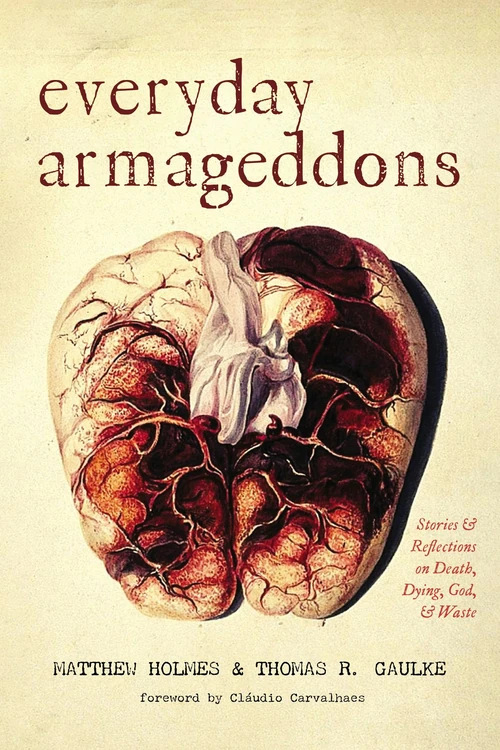
Everyday Armageddons
Stories and Reflections on Death, Dying, God, and Waste
- Counseling, Grief & Mental Health
- Publisher: Cascade Books (Wipf and Stock)
- Published: 2023
FritzSearch.com earns a commission on purchases made through Bookshop.org links.
Publisher's Description
Drawing from two decades as a hospice chaplain, nurses' aide, and emergency medical technician, the Rev. Matthew J. Holmes invites us to peer into the often occulted dimensions of life's endings. From bedsores to isolation, impacted bowels to the nursing home economy, from neglect to deep, desperate love, modern death's characteristics are navigated here with insight, honesty, depth, and clarity. Following the sense of horror and humor evoked in each narrative are theopoetic and theological reflections from the Rev. Thomas R. Gaulke, PhD. Tom brings a playfulness to the conversation, engaging issues of hope, meaningless, disenchantment, sacramentology, grace, and religiosity in relation to modern death and postmodern longing. Every day, worlds end. Armageddon is not a battle far removed into the future. It is taking place right now--in the hospital, at the nursing home, across the street, and inside our very bodies. The world ends in ways big and small. It ends in pain and in love. It ends with tears and with relief. The ends of worlds are often grotesque, final battles the bloodiest. This book is an opening into those endings and an invitation into the search for whatever meaning and whatever of God might lie therein.
Endorsements (2)
“Matthew Holmes and Thomas Gaulke have written an unsettling, gripping, and—ultimately—deeply humane book. Their book does not use theology as a panacea for suffering, but instead radically inserts—or, rather, recognizes—the divine in the most abject places of our human experience. Read it and be disturbed; read it and be strangely comforted.”
“In Everyday Armageddons the authors weave together the mundane, wondrous, and wounding aspects of our mortality through storytelling, theology, and theopoetics. The narratives are raw, harsh, and compelling, inviting us to confront our perceptions, beliefs, values, theologies, and practices around death and dying. Together, they ask us to consider what it would mean to sustain practices of care, tenderness, and dignity—in health and sickness, from womb to tomb, and every breath in between.”
See something wrong on this page? Report a problem