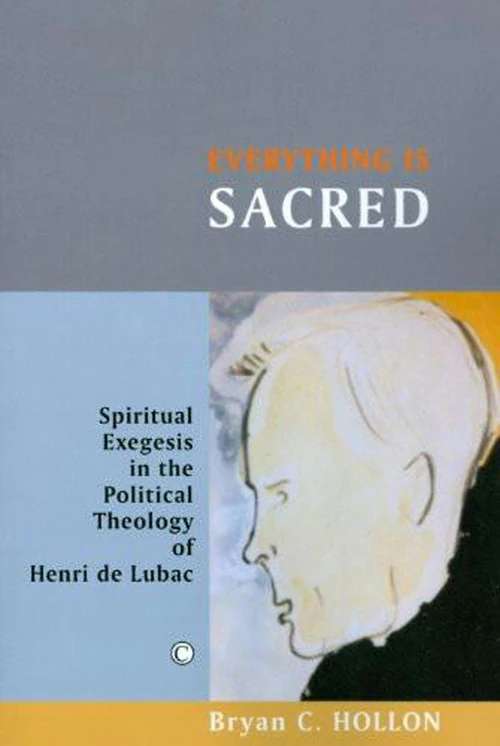
Everything Is Sacred
Spiritual Exegesis in the Political Theology of Henri de Lubac
- Theology
- Publisher: Cascade Books (Wipf and Stock)
- Published: 2009
FritzSearch.com earns a commission on purchases made through Bookshop.org links.
Publisher's Description
It is well known that Henri de Lubac's groundbreaking and highly controversial work on nature and grace had important implications for the Church's relationship to culture and was intended to remove a philosophical obstacle hindering Catholicism's faithful engagement with the secular world. This book addresses a too-often neglected dimension of de Lubac's theological renewal by examining the centrality and indispensability of spiritual exegesis in his oeuvre and making explicit its social and political significance for the Church's worship and witness. In addition to exploring the historical and ecclesial context within which he worked, the current work brings de Lubac into a critical engagement with the more recent theological movements of postliberalism and radical orthodoxy in order to demonstrate the enduring significance of his theological vision.
Endorsements (1)
“Hollon offers the best introduction to date on de Lubac's spiritual interpretation of Scripture. His bold recovery of Henri de Lubac's participatory hermeneutic offers an excellent contribution to the rapidly growing scholarship on the French Catholic theologian. The book argues for a hermeneutic that avoids the dual trap of isolating Jesus' biblical identity from the life of the Church (the post-liberal tendency) and of reducing Christology to ecclesiology (the fallacy of Radical Orthodoxy). Hollon convincingly argues that the Church's ontological participation in Christ is mediated through the practice of spiritual interpretation along the lines advocated by de Lubac. The result is both an incisive, sympathetic-critical engagement with contemporary hermeneutics and a superb introduction to one of the central concerns of de Lubac.”
See something wrong on this page? Report a problem