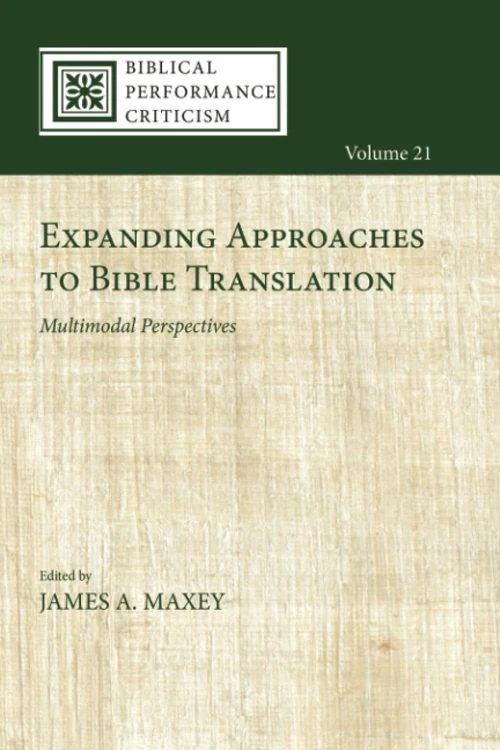
Expanding Approaches to Bible Translation
Multimodal Perspectives
- Biblical Studies & Commentaries
- Publisher: Cascade Books (Wipf and Stock)
- Published: 2025
FritzSearch.com earns a commission on purchases made through Bookshop.org links.
Publisher's Description
The assertion in this book, included within the BPC series, is that translation is as fundamental to biblical material as performance--both in its history as well as in its research approaches. Translation in this sense is more than a transferal of meaning from one linguistic system to another. Bible translation highlights innovative connections and conceptions to biblical texts, in their promulgation, reception, and ever-changing nature. A predominant theory used throughout this book is social semiotic multimodality. This communication theory informs an approach to translation that expands beyond words to other semiotic resources. Sign Language, embodied performance, social media, theater, materiality, and many other types of multimodal communications inform translation. It is important to understand that the Bible is a translated experience. Translation reflects the various ways in which the Bible has been mediated and appropriated throughout history. It follows, therefore, that Bible translation, as a global activity, has been and continues to be influenced by the political and economic flows of history. Race, class, ethnicity, gender, sexual orientation, and other elements of our social locations directly influence the enterprise and results of Bible translation.
Endorsements (5)
“Those of us who do our biblical studies work in African contexts understand just how important translation studies are, constituting a significant component of ‘African biblical studies.’ This edited collection of essays enables us to understand just why translation studies are so important, combining emerging theory with particular practices and intersecting biblical textual orientations with a focus on orality and performance. Translation in general, and biblical translation in particular, is more complex and includes more than we have envisaged. This interdisciplinary volume, both as a product and a process, summons us to delve more deeply into translation.”
“This timely collection is a must-read for anyone seeking to understand the growing multimodal movement in Bible translation. As each new author takes their turn, they open our eyes to a broader perspective that not only integrates sign language and oral translations but puts them center stage. As with all good performances, the book challenges us to think afresh: confronting long-cherished assumptions about values and processes, and even the nature and purpose of Bible translation.”
“Despite the accelerating advances in translation studies, Bible translation has been relatively stuck in a linguistic conceptualization of what the Bible is and how it should be translated across cultures. This book is ground-breaking in its attempt to challenge narrow perspectives on Bible translation, using recent developments in translation studies, multimodality, semiotics, and biblical performance criticism. Maxey has successfully brought ten contributors with unique academic and professional backgrounds to pose key questions about experiencing the materiality of Bible translation. This is a must-read for scholars, Bible translators and anyone passionate about Bible engagement in different modalities.”
“By viewing Bible translation beyond its interlinguistic dimension as a modern-day performance of ancient biblical traditions, this volume succeeds in a novel way to move biblical performance criticism within the milieu of a sophisticated theoretical approach of multimodal translation. Modes combine forces to excel for specific purposes. As a project of ten collaborators on intersemiotic Bible translation challenging the great divide between oral and written, the essays follow a recent trend in translation studies.”
“The book’s engagement with multimodality, materiality and performance in relation to Bible translation processes is a welcome broadening of the field and a contribution to scholars working in the field of Bible translation, including Bible translators.”
See something wrong on this page? Report a problem