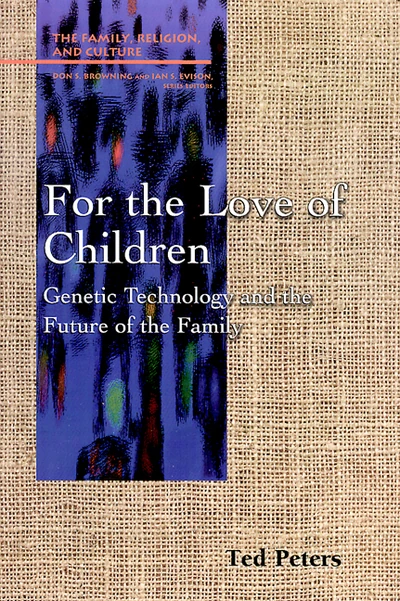
For the Love of Children
Genetic Technology and the Future of the Family
- Ethics, Culture & Social Issues
- Science & Faith
- Publisher: Westminster John Knox
- Published: 1996
FritzSearch.com earns a commission on purchases made through Bookshop.org links.
Publisher's Description
Choices in reproductive technology have multiplied at a staggering rate. Is our society prepared to decide on issues about procreation (artificial insemination and invitro fertilization) or genetic engineering (“designer children” and selective abortion)? How can we protect children–both born and unborn–who are conceived in these ways from being regarded as merchandise in the expanding marketplace of genetic services? Ted Peters sets out the challenges of these new technologies with clarity and precision. He looks anew at Christian theology and proposes an ethic “for the love of children.” Peters contends that only by affirming all children and their claims upon parents will society deal constructively and ethically with the many reproductive choices available now and in the future. The Family, Culture, and Religion series offers informed and responsible analyses of the state of the American family from a religious perspective and provides practical assistance for the family’s revitalization.
Endorsements (1)
“In For the Love of Children, Peters believes that increased choice is a fact of contemporary American life and that a choice by parents (regardless of number and gender) is urgently needed to make covenant with children, to commit to loving them with a regard equal to or even greater than the parents' own pursuit of their self-fulfillment. In the midst of the possibilities afforded by genetic technology, the love of children must be primary in all decision-making. 'Children,' he urges, 'need commitments and covenants.' And we cannot assume that the marital covenant automatically reaches to children in our choice rich society. Not only are marriages fragile and in need of undergirding covenants; parenthood is equally and additionally demanding. Sociobiology may partly explain why fathers care, but it does not explain why fathers abandon and abuse. People must decide to be responsible; but with such a covenant, parenthood and personal self-fulfillment can be complimentary. Our love of children must be based not on inheritance myths or being made to our specifications, but on the dignity of their promise as citizens of the kingdom of God.”
See something wrong on this page? Report a problem