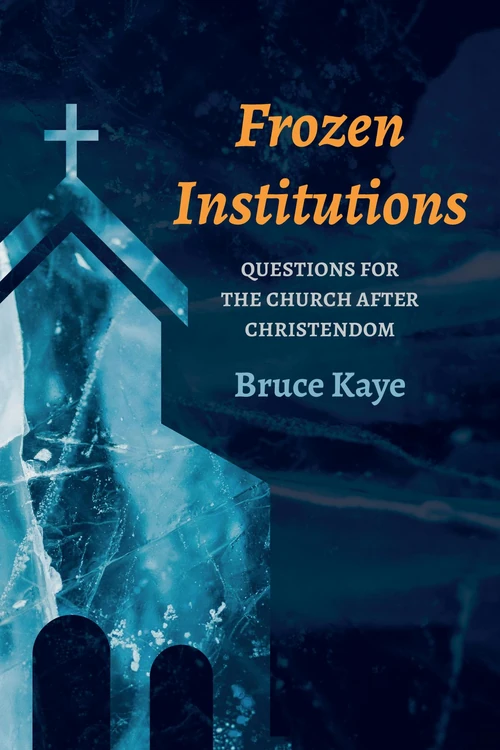
Frozen Institutions
Questions for the Church after Christendom
- Church Leadership & Ministry
- Publisher: Pickwick Publications (Wipf and Stock)
- Published: 2022
FritzSearch.com earns a commission on purchases made through Bookshop.org links.
Publisher's Description
Thanks for the memories--well, maybe not. It has been hard work getting over the break up of the fifteen-hundred-year Anglican marriage of church and state--the so-called English Christendom. It is still a work in progress because the marriage left behind so many unconscious assumptions about power, institutions, and community relations. The first group of essays in this book challenges some of the frozen elements in church institutions, in particular habits of orthodoxy, catholicity, and canonical Scripture. They are framed in the context of the struggles of the Anglican Communion. The second set of essays refer to the Anglican Church of Australia and some attempts at de-frosting its institutions. These are lectures and papers given across Australia mostly during the author's time as General Secretary of the Anglican Church of Australia. The last essay is an account of a current struggle over the blessing of a same-sex couple legally married under recently changed civil law. It illustrates the role of the constitution of the church in this dispute. The loose federation of dioceses in the constitution has generally enabled dioceses to live separately. The danger in this has been the specter of a church made up of diocesan silos rather than of engaged fellowship. However, the federal structure does not need to work that way. Indeed, in the present conflict situation this very looseness could be used to provide space for more respectful engagement. How this crisis is handled will be an early clue as to whether the church is up to it.
Endorsements (5)
“What do we have to learn from the Anglican church in Australia about how the church faces the challenge of the end of Christendom? The answer is that we have much to learn if our teacher is Bruce Kaye. Kaye is a no-nonsense theologian who makes these essays shine with clarity and wisdom. All who are trying to think through what it means to live as Christians after that is no longer a given will benefit from Kaye’s book.”
“Leadership through liminality requires re-embracing identity, recalling our formative story. Second, it requires courageous experimentation and imaginative exploration to discover how our identity might be expressed in changed circumstances. Finally, it involves discerning effective ways forward, consonant with our identity, as they emerge from experiments. In this collection of essays, Bruce Kaye offers this kind of leadership; with theological and historical acuity and insightful analysis, he creatively opens future possibilities.”
“Frozen Institutions is a wonderful compendium of essays . . . . With insight and sharpness, Kaye brings his considerable skills as a wise and astute interpreter of the faith and fortunes of the Anglican Church worldwide as it grapples with issues of diversity and plurality in the modern world. A scholarly, penetrating, at times disturbing yet unfailingly gracious account of the ecclesia of God.”
“There is no better student of the life and witness of the body of Christ than Bruce Kaye. An Anglican theologian deeply committed to and thoroughly engaged in the church in Australia and globally, Kaye is a sharp critic of the forces that undermine the church’s faithfulness to the gospel. These essays offer a hopeful future for both the Anglican Communion and Australian Anglicanism beyond Christendom and its divisive power politics. Good news indeed!”
“Ranging over Anglican, Australian, and ecumenical territory, Kaye shows that the institutional embodiment of religious faith is essential for its faithful transmission from one generation to another. But Kaye also urges a process of ecclesial reform and development if faith is to remain a reality in the world. With its focus on structures of power and authority (and their abuse), this is a book to resource and reorientate our thinking.”
See something wrong on this page? Report a problem