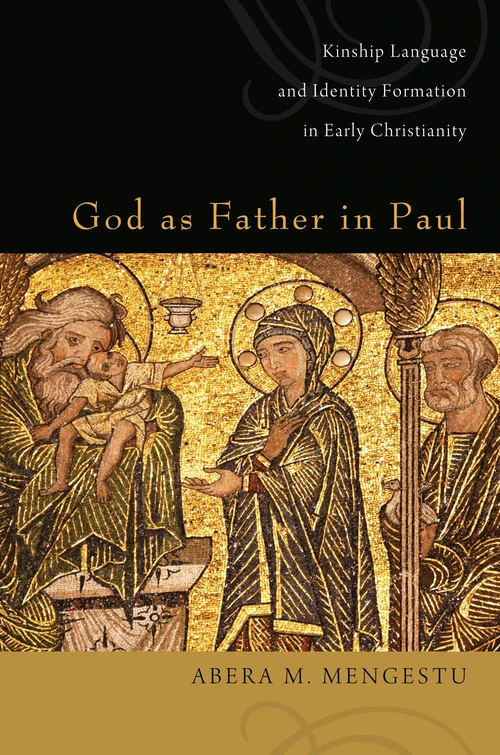
God as Father in Paul
Kinship Language and Identity Formation in Early Christianity
- Biblical Studies & Commentaries
- Publisher: Pickwick Publications (Wipf and Stock)
- Published: 2013
FritzSearch.com earns a commission on purchases made through Bookshop.org links.
Publisher's Description
God as Father in Paul explores Paul's use of the kinship term "Father" to refer to God, along with related familial terms ("children" of God and Christ-followers as "brothers and sisters"), as part of a study of the use of kinship language in the identity formation of early Christianity. Mengestu argues that these kinship terms are shared modes of identity constructions within the wider textual and cultural settings (the Roman Empire, the Roman Stoic philosophers, the Hebrew Bible, and ancient Jewish literature) from which Paul draws on as well as contests. Employing theoretical (kinship and social identity theory) as well as interpretative approaches (imperial critical and narrative approaches to Paul), he contends that Paul uses God as Father consistently, strategically, and purposefully, in both stable and crisis situations, to develop a narrative, orienting framework(s) that images the community of Christ-followers as a family that belongs to God, who, together with the Lord Jesus Christ, bestows on them equal but diverse membership in the family. The narrative so constructed forms the foundation for referring to Christ-followers as "children of God" and "brothers and sisters" of one another. It constructs boundaries and serves as nexus of transformation and negotiation.
Endorsements (3)
“This is a thoughtful, rich, and creative study. Abera Mengestu employs kinship-identity theories to examine the identity-forming function of Paul's use of the term 'father' and its derivatives of 'children' and 'brother and sister,' locating Paul's work in active and diverse interaction with imperial and Jewish traditions. This is an important contribution to studies of Paul's language, identity-formation work, and the understanding of Pauline communities.”
“This fascinating study uncovers key kinship and identity-forming discourses found in Paul's references to God as Father and, derivatively, to Christ-followers as children of God and brothers and sisters. Mengestu's kinship-identity approach offers a methodologically rich framework for understanding the highly contextualized identity of the earliest Christ-following community. His avoidance of conflict as a primary hermeneutic provides a much-needed corrective to studies of early Christ-movement origins.”
“God as Father in Paul is an excellent exploration of the imagery of familial relationships and their function in identity construction for Pauline communities. Mengestu carefully situates these terms and images in the broader socio-cultural contexts of early Judaism and the Roman Empire as he explores Paul's usage in relation to identity formation in the Pauline communities. . . . Methodologically sophisticated, God as Father in Paul offers a unique contribution to Pauline studies.”
See something wrong on this page? Report a problem