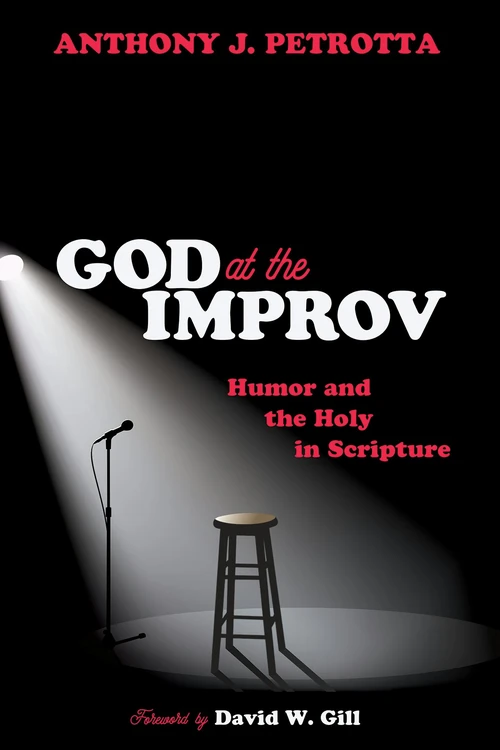
God at the Improv
Humor and the Holy in Scripture
- Biblical Studies & Commentaries
- Publisher: Cascade Books (Wipf and Stock)
- Published: 2020
FritzSearch.com earns a commission on purchases made through Bookshop.org links.
Publisher's Description
Asking if there is humor in any religious text might seem blasphemous to many readers. Religious texts are there to instruct us, not entertain us. Religious texts are serious works, not frivolous. However, if part of being human entails having a sense of humor, then it would be more surprising indeed for Scripture not to have humor. Humor instructs us as much as it entertains us. God at the Improv seeks to show that being religious and being humorous are not opposites, but actually work in tandem to enhance and enliven our faith and practice.
Endorsements (9)
“With a style both learned and witty, Petrotta ranges through the biblical canon, illuminating from a surprising angle texts that are often overlooked or dismissed. He shows that an expanded notion of humor is vital for probing exegesis, that biblical humor is itself a mode of theological reflection. This is serious scholarship of the most pleasurable kind, suitable for a wide audience of scholars, students, and readers, both Jews and Christians.”
“Anthony J. Petrotta’s elegant examination of the structure and function of humor in the Bible combines the accumulated knowledge of a professor, the practical wisdom of a pastor, and the mature faith of a lifelong disciple. God at the Improv deftly balances erudite analyses by Kierkegaard and Niebuhr with pithy witticisms from Woody Allen and Chuck Jones. Exhibiting both careful scholarship and a sanctified imagination, this book achieves the twin goals of all successful writing: it delights even as it instructs.”
“I always felt Luke was the funniest writer in the Bible. Eutychus means ‘lucky.’ But Dr. Petrotta has opened my eyes to the extent and depth of humor in Scripture. Humor is the capacity to discover and express the absurd; this becomes all the more clear when the status quo is backlit by God’s kingdom. We should laugh at whatever culture props up as god.”
“Tony’s serious scholarly understandings are livened by his sense of humor—a welcome surprise that will keep readers smiling as they learn.”
“Anthony Petrotta’s latest work, God at the Improv, offers a delightfully refreshing and intellectually challenging contextualization of humor via the lens of Scripture. While Petrotta’s keen eye for uncovering instances of humor functioning as a rhetorical feature of the text is both laudable and impressive, it is his implicit invitation for us to consider a sense of humor among God’s immutable characteristics that sets this book apart.”
“For me, the best part of humor is the surprise. ‘I didn’t expect that!’ That twist brings a smile, a twinkle, a laugh. In this delightful book, Tony Petrotta shows us that the God of the Bible is full of surprises: with Sarah, Jonah, Elijah, Jesus, and more. Whenever God steps in, our mouths are filled with laughter, and our tongues with songs of joy (Ps 126). This book gives us a playful, slanted glimpse at biblical truth, and leaves us with a sense of awe and a smile.”
“Many people find the idea of humor in the Bible unacceptable. Salvation is serious business, they say, and there is no place here for the frivolous and playful. Petrotta shows us another way. Gently, firmly, delightfully, he shows that the Scripture is full of humor. From the laughter of Sarah to the repartee of the Syrophoenician woman humor is everywhere in the Bible. This book will make you think . . . and imagine. Above all, it will make you laugh.”
“Petrotta’s readings revel in Scripture’s comic rhetoric as being inherent to its transformative purpose. He shows us both how to read and how to live. The Bible’s humor in his framing embraces an array of tropes and literary strategies that guide the trusting reader toward authentic life under God, whose grace is essentially comic without negating tragic reality. These readings show how humor anticipates faith, requiring much the same dispositions.”
See something wrong on this page? Report a problem