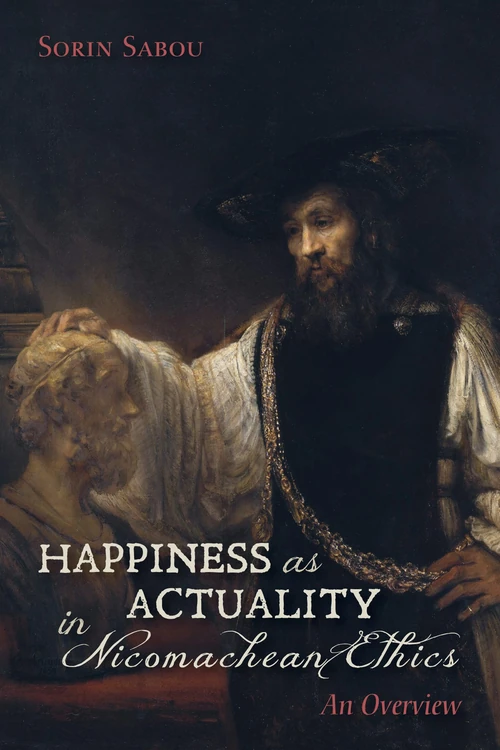
Happiness as Actuality in Nicomachean Ethics
An Overview
- Philosophy
- Publisher: Pickwick Publications (Wipf and Stock)
- Published: 2018
FritzSearch.com earns a commission on purchases made through Bookshop.org links.
Publisher's Description
This is a study about the meaning of happiness (εὐδαιμονία) in Aristotle's Nicomachean Ethics (EN). It is argued that εὐδαιμονία in EN means actuality, and it has to be interpreted through the lenses of two metaphors used by Aristotle in EN 1.7 1098a21 and 10.6 1176a30: the "perimeter of good" and the "imprint of happiness." To explain the meaning of happiness Aristotle first has to delineate the "perimeter of good" of human beings, and he does that with the help of two criteria: the final end [τέλος] and the function of humanity [ἔργον ἀνθρώπου]. These two criteria are metaphysical concepts which describe the "good" as the final metaphysical aim of every person, and the best every person can be. This metaphysical teleological aim is the "actuality of the soul" according with excellence. This is the "perimeter" within which Aristotle enquires about εὐδαιμονία--the good of humans.
Endorsements (1)
“Remarkable in its erudition, through detailed analyses and fresh approaches, Sabou's book offers a new reading of Aristotle’s inquiry on happiness based on only two interpretative metaphors. The whole architecture of Aristotle’s ethical theory is reconstructed on this basis. It's a book devoted to critically-minded students trained to penetrate the endless strata of surprising assumptions.”
See something wrong on this page? Report a problem