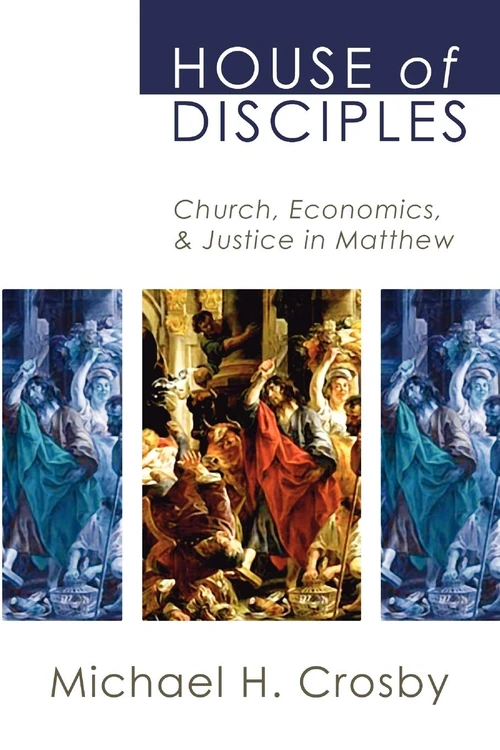
House of Disciples
Church, Economics, and Justice in Matthew
- Biblical Studies & Commentaries
- Publisher: Wipf and Stock
- Published: 2004
FritzSearch.com earns a commission on purchases made through Bookshop.org links.
Publisher's Description
The household was the basic unit of the early church; it also constituted the basic unit of political economy until the Industrial Revolution. This richly detailed work uses the notion of house as a unifying theme, establishing the identity and concerns of the early Christian churches. What emphases did Matthew's gospel have for that audience - which Crosby establishes was urban-based and prosperous - and what does it mean to First World Christians today? Through an in-depth exploration of Matthew's gospel and its socioeconomic milieu, 'House of Disciples' shows how the world of the early church continues to challenge Christians nineteen hundred years later. It makes a unique contribution to both New Testament scholarship and the practice of a contemporary spirituality.
Endorsements (4)
“We are presently amidst a very creative moment in the relating of scripture to ethics, and not least to some of the most important and problematic issues of the day - such as economic ones. Michael Crosby's book is an exegetically detailed and timely contribution.”
“A fresh, challenging reading of Matthew's gospel from the perspective of economic justice. Using the metaphor of the 'household, ' Crosby highlights Matthew's interest in having the gospel of Jesus transform every level of our relationships. His conclusions drive home the meaning of the gospel for a First World church.”
“Michael Crosby proffers not only startling new insights about Matthew's gospel but also meticulously constructs an exciting new mode of reading and understanding the scriptures altogether. We are not forced to leave the Bible's struggle with economy lodged in the first century, as modern exegesis has assiduously taught us to do. Rather, Crosby shows how the struggles of the first-century members of the household of Jesus Christ with authority, the division of labor, and the just distribution of social goods, can have a qualitative impact on those who struggle with these same questions in our time.”
“This skillfully crafted study makes a significant advance toward overcoming the tragic separation between faith and daily life, spirituality and ethics, the scriptures and economic responsibility. Michael Crosby ably demonstrates that justice, understood as 'rightly-ordered relationships' with others and with God, is central to Matthew's account of both church and economics. By bringing the Matthean data on justice into conversation with contemporary economics and ecclesiology, Crosby issues a compelling call for expressions of Christian discipleship at once deeply contemplative and political.”
See something wrong on this page? Report a problem