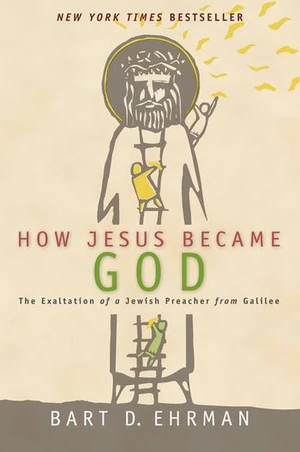
How Jesus Became God
The Exaltation of a Jewish Preacher from Galilee
- Theology
- Publisher: HarperOne
- Published: 2015
FritzSearch.com earns a commission on purchases made through Bookshop.org links.
Publisher's Description
New York Times bestselling author and Bible expert Bart Ehrman reveals how Jesus’s divinity became dogma in the first few centuries of the early Church. The claim at the heart of the Christian faith is that Jesus of Nazareth was, and is, God. But this is not what the original disciples believed during Jesus’s lifetime—and it is not what Jesus claimed about himself. How Jesus Became God tells the story of an idea that shaped Christianity, and of the evolution of a belief that looked very different in the fourth century than it did in the first. A master explainer of New Testament history, texts, and traditions, Ehrman reveals how an apocalyptic prophet from the backwaters of rural Galilee crucified for crimes against the state came to be thought of as equal with the one God Almighty, Creator of all things. But how did he move from being a Jewish prophet to being God? In a book that took eight years to research and write, Ehrman sketches Jesus’s transformation—the development of early Christology—from a human prophet to the Son of God exalted to divine status at his resurrection. Only when some of Jesus’s followers had visions of him after his death—alive again—did anyone come to think that he, the prophet from Galilee, had become God. And what they meant by that was not at all what people mean today. A work of compelling biblical scholarship written for secular historians of religion and believers alike, How Jesus Became God will engage anyone interested in the historical developments that led to the affirmation at the heart of Christianity: Jesus was, and is, God. How did this belief take hold? Historical Jesus Scholarship: Explore the difference between the Jesus of history, an apocalyptic prophet from Galilee, and the Christ of faith. Early Christian Beliefs: Trace the evolution of doctrine through the first centuries, showing how the claim that Jesus was God was not what the original disciples believed during his lifetime. The Role of the Resurrection: Understand why the visionary experiences of Jesus’s followers after his death became the turning point in the development of Christian doctrine. Ancient Historical Context: Discover the surprising world of divine humans, sons of God, and exalted rulers in Greek, Roman, and even Jewish traditions that shaped how early Christians saw Jesus.
Endorsements (5)
“Bart Ehrman has done it again! In this lively and provocative book, he gives a nuanced and wide–ranging discussion of early Christian Christology and all that it entails. Tracing the developing understanding of Jesus from a fully human apocalyptic preacher to a fully divine being, Ehrman shows his skills as an interpreter of both biblical and nonbiblical texts. This is an important, accessible work by a scholar of the first rank.”
“HOW JESUS BECAME GOD makes the most astonishing and complex topic in the history of Christianity accessible to every reader, and offers a clear and balanced discussion of how various Christians–and non- Christians-see Jesus.”
“Ehrman writes with vigor and clarity, but above all with intellectual honesty. He demystifies a subject on which biblical scholars too often equivocate. Both believers and non-believers can learn much from this book.”
“This careful book starts where the ‘historical Jesus’ accounts ends and lays out how this absorbing story continued for centuries. Candid and direct, it unfolds what often seem to be the unnecessarily complicated controversies that divided early Christians in a fair and understandable manner.”
“How did ancient monotheism allow the One God to have a ‘son’? Bart Ehrman tells this story, introducing the reader to a Jewish world thick with angels, cosmic powers, and numberless semi-divinities - among whom, for this tiny messianic sect, Jesus of Nazareth, raised from the dead. How Jesus Became God provides a lively overview of Nicea’s prequel.”
See something wrong on this page? Report a problem