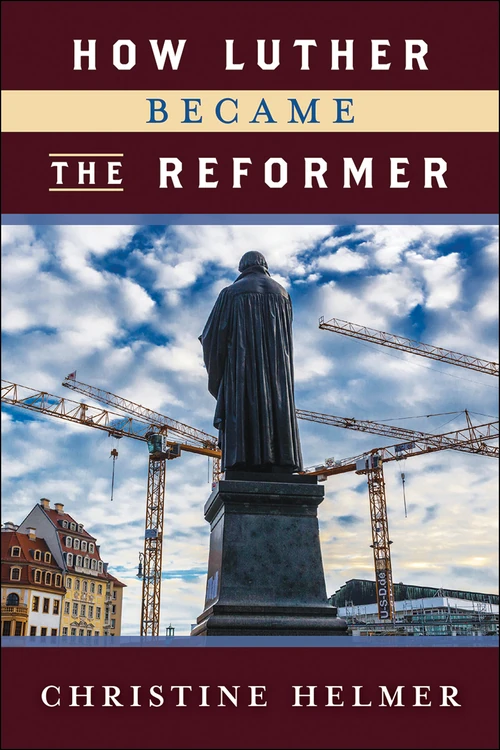
How Luther Became the Reformer
- History & Biography
- Publisher: Westminster John Knox
- Published: 2019
FritzSearch.com earns a commission on purchases made through Bookshop.org links.
Publisher's Description
No story has been more foundational to triumphalist accounts of Western modernity than that of Martin Luther, the heroic individual, standing before the tribunes of medieval authoritarianism to proclaim his religious and intellectual freedom, “Here I stand!” How Luther Became the Reformer returns to the birthplace of this origin myth, Germany in the late nineteenth century, and traces its development from the end of World War I through the rise of National Socialism. Why were German intellectuals—especially Protestant scholars of religion, culture, and theology—in this turbulent period so committed to this version of Luther’s story? Luther was touted as the mythological figure to promote the cultural unity of Germany as a modern nation; in the myth’s many retellings, from the time of the Weimar Republic forward, Luther attained world-historical status. Helmer finds in this construction of Luther the Reformer a lens through which to examine modernity’s deformations, among them anti-Judaism, anti-Semitism, and anti-Catholicism. Offering a new interpretation of Luther, and by extension of modernity itself, from an ecumenical perspective, How Luther Became the Reformer provides resources for understanding and contesting contemporary assaults on democracy. In this way, the book holds the promise for resistance and hope in dark times.
Endorsements (4)
“This book is perceptively, importantly disturbing. There have been many quality biographies of Luther and examinations of his theological effects. But no other work explains the consequences of the wrongheaded myth of Luther. Through sharp readings and revisions, Helmer pulls Luther from a harmful hermeneutic and reminds us again that the way we explain our human past very much determines our capacity to live into a truly freer present.”
“With an elegant weave of intellectual history and constructive theological reflection, Christine Helmer retrieves the Catholic Luther to challenge the regnant Protestant image of the former Augustinian monk as advocating a radical break with the Roman Church. By contextualizing the construction of the reigning Reformation narrative within early twentieth-century German political and cultural discourse, she exposes its anti-Catholic and anti-Judaic presuppositions to be primed by a political theological agenda that was defiantly supersessionist. In her deft deconstruction of the Reformation Luther, Helmer compellingly calls for a revision of the conception of religion and modernity promoted by the Protestant narrative.”
“With impressive clarity and insight, Christine Helmer presentsa vivid understanding of how the medieval Catholic reformer was mythologized into the great Protestantreformer.”
“A century ago, most Protestants viewed Martin Luther as the great prophet of freedom who liberated the West from the oppressive rule of medieval Catholicism and set Western churches, states, and cultures on the road to modernity. Christine Helmer has long shown us that Luther’s reformation was far more medieval, far less revolutionary, and far more complex in influence than the heroic image of Luther would have it. This learned volume exposes the tangled roots and routes of this heroic Luther myth in modern German thought, challenging everyone from Hegel and Schleiermacher to Weber and Holl for their highly selective and present-minded readings of Luther. This is forensic critical historiography at its best.”
See something wrong on this page? Report a problem