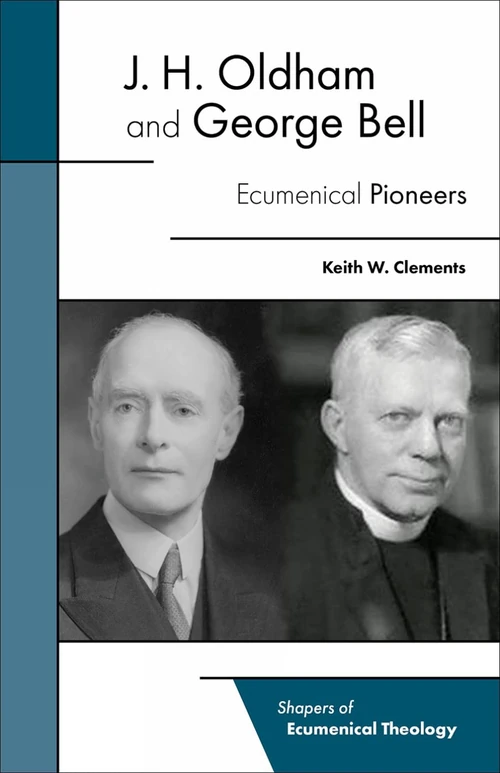
J. H. Oldham and George Bell
Ecumenical Pioneers
- History & Biography
- Publisher: Fortress Press (Augsburg Fortress)
- Published: 2022
FritzSearch.com earns a commission on purchases made through Bookshop.org links.
Publisher's Description
This book introduces the life and thought of two British contemporaries who were decisive in shaping the modern ecumenical movement: the Scottish layman J. H. (Joe) Oldham (1874-1969) and the Anglican bishop G. K. A. (George) Bell (1883-1958). Their careers were rather different but closely related. Oldham was a missionary statesman, the organizing secretary of the 1910 Edinburgh World Missionary Conference, and a pioneering thinker and writer on race and social ethics who set the agenda for the crucial ecumenical conference on Church, Community, and State at Oxford in 1937. A quiet, skillful diplomat, he was the decisive mind behind the formation of the World Council of Churches (WCC). Bell was the public, prophetic voice of the ecumenical fellowship from the 1930s onward, steadfastly leading the churches' support for the Christian opposition to Hitler in Germany, tirelessly working for refugees and all victims of oppression, and after the war pioneering the work of reconciliation. After the inauguration of the World Council of Churches in 1948, he served as the first chairman of its central committee. It was widely believed that he would have become Archbishop of Canterbury but for his courageous and outspoken opposition to the British and American policy of bombing civilian populations during the war. The book outlines the life and main engagements of each figure in turn, and then provides a selection of their key writings to illustrate their thinking and their impact on ecumenism. A final chapter reflects on their pioneering significance and their relevance today.
Endorsements (4)
“With his characteristically careful scholarship, deep historical knowledge, and real insight into the personal motives of these two ecumenical pioneers, Keith Clements retrieves and illuminates the foundational dynamics of this formative period of ecumenism. His work also sheds light on the enduring role of the ecumenical movement in world affairs and the prospects for renewal of the fellowship of Christian churches. A singular achievement.”
“As an homage to two among the most influential ecumenists of all time, this book provides insights that need to be studied by generations of ecumenists to come. It is inspirational for the churches today in their search for new ecumenical responses in a post-colonial world.”
“Keith Clements brings his own ecumenical experience to bear in an insightful overview of the work of two of the most influential British ecumenicists of the twentieth century. The final comparative essay is a tour de force, examining not only the legacy of Oldham and Bell but also the development of the ecumenical movement since 1960. In the light of developments such as liberation theology, feminist theology, and post-colonialism Clements makes a convincing case that Oldham and Bell still have much to offer.”
“Clements’s fine work values the best in Oldham and Bell without being apologetical. This primer leads the reader into history while it points to challenges we face today, and thus provides a convincing motivation to continue the costly and precious—albeit often precarious—ecumenical and prophetic engagement into the future.”
See something wrong on this page? Report a problem