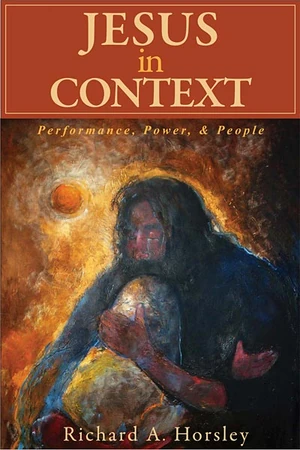
Jesus in Context
Power, People, and Performance
- Biblical Studies & Commentaries
- Publisher: Fortress Press (Augsburg Fortress)
- Published: 2008
FritzSearch.com earns a commission on purchases made through Bookshop.org links.
Publisher's Description
What difference did empire make for Jesus and his disciples? What difference did empire make for the broader social currents of which he and they were a part? What social roles did Jesus perform, what "little tradition" did he embody against the "great tradition" of Roman culture? What difference does it make for our understanding of Jesus if we attend to new kinds of evidence regarding popular movements, the dynamics of oral tradition, and reading history "from below"? Richard A. Horsley addresses all these questions and sketches a dramatic new picture of Jessus in light of recent approaches.
Endorsements (2)
“For some time now, Richard Horsley's exploration of Jesus and the early traditions about him has been a performance in plural registers. He has sought at once to unify economic history and power politics, popular memory and elite traditions, oral performance and oral-derived texts. In Jesus in Context, he realizes a new synthesis, infusing new life into the study of Christian origins and giving us a people's history deeply rooted in the turmoil of the time and in the memories of Israel. In a field where scholarship is all too often narrowly focused, these chapters represent a refreshing enlargement of our historical vision.”
“In this stimulating work Richard Horsley engages the rich tradition of scholarship questing for the historical Jesus. He finds notions of strata and criteria — based in print culture — anachronistic and inadequate. Instead he utilizes an array of quite different approaches — oral performance, limited literacy, social memory, public and hidden transcripts, great and little traditions, people's history, imperial context — to understand Jesus and the early Jesus movement in their first-century world. An intriguing, insightful, and innovative study."”
See something wrong on this page? Report a problem