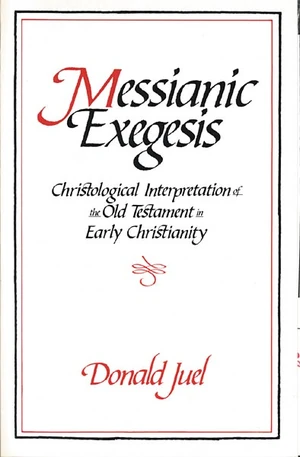
Messianic Exegesis
Christological Interpretation of the Old Test. in Early Christianity
- Biblical Studies & Commentaries
- Publisher: Fortress Press (Augsburg Fortress)
- Published: 1992
FritzSearch.com earns a commission on purchases made through Bookshop.org links.
Publisher's Description
Professor Juel defends a simple thesis: "The beginnings of Christian reflection can be traced to interpretation of Israel's scriptures, and the major focus of that scriptural interpretation was Jesus, the crucified and risen Messiah." He therefore proceeds to demonstrate how certain Old Testament texts came to be applied to Jesus as Christ. He argues that the interpretative application of such texts to Jesus was part of the interior logic of Christianity. Introduction Messianic Exegesis: Developing an Approach Biblical Interpretation in the First Century C.E. Christ the King: Christian Interpretation of 2 Samuel 7 Christ the Crucified: Christian Interpretation of the Psalms The Servant Christ: Christian Interpretation of Second Isaiah Christ at the Right Hand: The Use of Psalm 110 in the New Testament The Risen Christ and the Son of Man: Christian Use of Daniel 7 Conclusion Notes Bibliography Index of Passages
Endorsements (2)
“Professor Juel has given us a brilliant work of disciplined imagination . . . and for my part I detect a breath of fresh air . . . Professor Juel's book makes an extremely valuable contribution not only to the study of how the earliest Christians interpreted the Hebrew Scriptures but also to our understanding of Christian origins.”
“Though the relationship between Jewish modes of exegesis and the New Testament is recognized by everyone, few scholars actually succeed in illustrating that connection in intimate detail. Into the short and exclusive list of expert exegetes who can uncover the dynamic argument of a New Testament text, we must now put Donald Juel, whose new book Messianic Exegesis will certainly serve as a mode for how to investigate the problem of the use of the Old Testament in the New in the future.”
See something wrong on this page? Report a problem