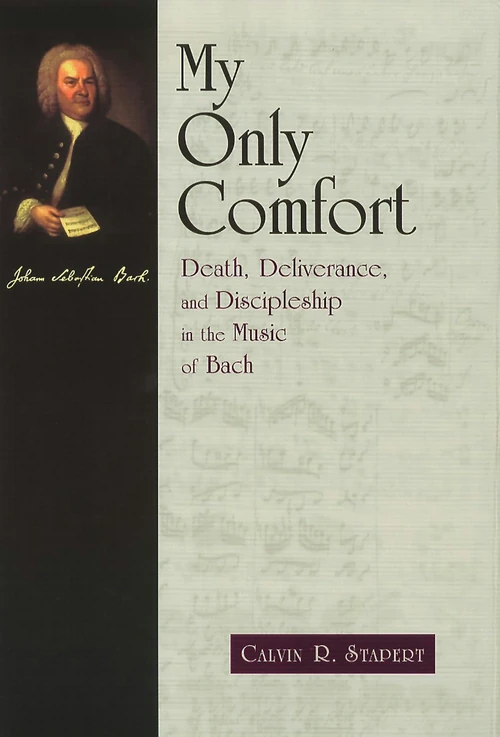
My Only Comfort
Death, Deliverance, and Discipline in the Music of Bach
- Arts & Literature
- Publisher: Eerdmans
- Published: 2000
FritzSearch.com earns a commission on purchases made through Bookshop.org links.
Publisher's Description
In the history of Western music, J. S. Bach is unsurpassed in mastery of technique and profundity of thought. He was also a devout Lutheran with a broad knowledge of Scripture and theology. Given Bach's combination of musical prowess, personal devotion, and theological depth, it is not surprising that his music stands unexcelled among artistic expressions of the Christian faith. With the passage of time, however, many of the essential keys to understanding Bach's music have been lost. My Only Comfort uniquely reconnects modern listeners with Bach's music, enabling them to listen to Bach with renewed understanding and appreciation. After an introduction to Bach, his theological knowledge, his musical language, and the various genres of sacred music in his output, Calvin Stapert leads readers through specific works by Bach that express, interpret, and vivify some of the principal doctrines of the Christian faith. For each work discussed, Stapert provides relevant quotations from the Heidelberg Catechism (a novel and provocative approach to the study of Bach), a literal translation of the text set beside the German original, and textual and musical commentary meant to contribute to a more perceptive and devotional listening to the work.
Endorsements (3)
“The noted humorist Garrison Keillor once said that Johann Sebastian Bach was a great musician because he was a Lutheran. The great liberal theologian James L. Adams, who disliked Luther, advanced the notion that Bach's music was, in fact, a fifth Gospel. Calvin Stapert here shows how both of those views are almost valid. He skillfully leads readers through the thicket of contentious commentary on Bach's biography, musicology, faith, and legacy, then offers a fresh, Reformational interpretation of the biblical-theological themes that lie at the core of Bach's work. Without understanding these, he argues, neither the inner structure of the music nor the enduring significance of its evangelical intent can be grasped. Through Stapert's book we gain a view of Bach as an artful, spiritual mentor for us all.”
“Amid all the noise of Bach-Year 2000, this is an especially marvelous and welcome contribution. Integrating theological and musical insights is rare enough in writing on Bach. Rarer still is what Calvin Stapert additionally brings to the subject—wisdom.”
“Here is a remarkable book. Calvin Stapert, a Calvinist, gives a clear and responsible introduction to Johann Sebastian Bach, a Lutheran, from a theological and musical standpoint. He then sets a Calvinist document, the Heidelberg Catechism, in dialogue with Bach's music. The result pushes beyond either Calvin or Luther to a faithful catholic breadth. This is a book for anyone who wants to get at the essence of J. S. Bach.”
See something wrong on this page? Report a problem