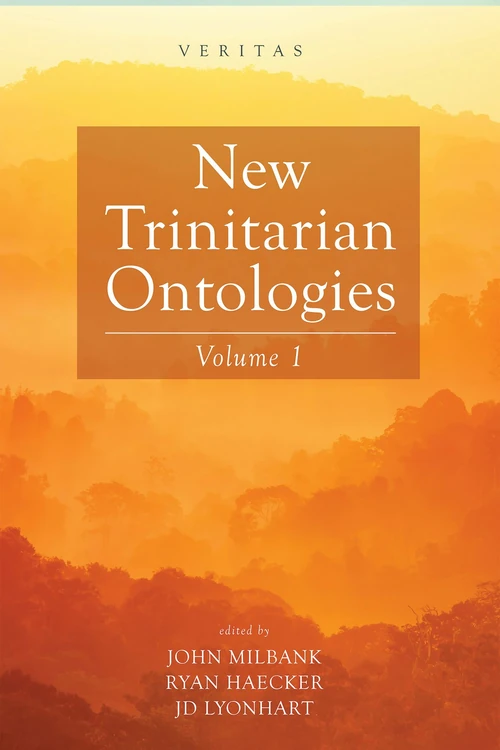
New Trinitarian Ontologies, Volume I
- Theology
- Publisher: Cascade Books (Wipf and Stock)
- Published: 2025
FritzSearch.com earns a commission on purchases made through Bookshop.org links.
Publisher's Description
The Holy Trinity is the oldest idea of Christian hope. The study of being or ontology was once regarded as a seminal preparation for the study of God as the creative cause of all being in theology. Yet due to a series of theological mistakes, metaphysics came to be separated from the Trinity before God came to be conceived as the supreme being of all beings in general metaphysics, natural theology, and modern ontology. The analytic and continental philosophical traditions have since tended to treat the Trinity as, at best, superfluous, and, at worst, redundant to modern formal ontologies. Yet the postmodern collapse of all such formal ontologies has prepared the path for a renewed study of metaphysics or ontology that shares in participation with the Trinity. New Trinitarian Ontologies names a creative response to this pivotal collapse of modern formal ontologies. If ontology cannot contain but rather more radically points to God, and if all nature thus tends towards the supernatural, the angelic, and the metaphysical, then we should renew the study of the metaphysics or ontology of the Trinity. This volume represents a collection of responses to this challenge of rendering ontology in a Trinitarian style. Introduction: Prolegomenon to Trinitarian Ontology, by Ryan HaeckerPart One—Trinitarian Ontologies1 For a Trinitarian Ontology: A Manifesto, by Piero Coda 2 A Relational Approach to Trinitarian Ontology, by Giulio Maspero 3 Time, Motion, and Mystery: The Narrative Metaphysics of the Trinity, by John MilbankPart Two—Metaphysics and Phenomenology4 Being, Identity, and Ecstasy: An Essay in Trinitarian Metaphysics, by John R. Betz 5 Trinitarian Kenosis and the Limits of Phenomenology, by Emmanuel Falque 6 Counting to Four: Metaxology and the Trinity, by William Desmond 7 Metacritique and the Dynamics of Retrieval: Radical Orthodoxy, Sergii Bulgakov, and the Task for Trinitarian Ontology, by Aaron KhokharPart Three—Ecology and Liturgy8 Entangled Unthinkably: Toward a Trinitarian Ecology, by Simone Kotva 9 Participation in the Divine Heart: On Faith and Trinitarian Knowing, by Katherine Apostolacus Part Four—Eschatology and Revelation 10 E schatological Being, by Judith Wolfe 11 Martin Heidegger’s Poetics and the End of Ontotheology: The “Passing By” of the “Ultimate God,” by Emily Stewart Long 12 From Tragic Ontology to Trinitarian Revelation: The Reconciliation with Being in Balthasar’s Reading of Nietzsche, by Paul Raimond DanielsPart Five—Poetics of Reconciliation13 Christ and the Destabilization of Time, by Graham Ward 14 Repetition and Re-Presentation: Reaching Eternity Through Beauty, by Isabelle Moulin 15 “ The Harmonious Silence of Heaven”: Silence, Analogy, and the Incarnate Christ in the Music of Olivier Messiaen and Arvo Pärt, by Joel Clarkson 16 God He Sees in Mirrors: “Nabokov’s Trinity” Revisited, by Erik Eklund
Endorsements (3)
“In a manner analogous to the Father, Son, and Holy Spirit—who are eternally new and surprising to one another within the Holy Trinity—New Trinitarian Ontologies reflects the ever-renewing surprise and gift of self-creation within all reality. More than just another theological or philosophical book, this volume brings together metaphysics, ecology, and poetics within the eschatological horizon, illuminating how all things participate in the unfolding mystery of divine life.”
“This superb collection of essays edited by John Milbank, Ryan Haecker, JD Lyonhart is after the various deaths triumphantly announced, such as the death of God, the death of Metaphysics, the death of the sign, and moves forward on Piero Coda’s call for a new beginning of Trinitarian thought framed in term of the Word which in John’s Gospel is associated with the true ‘beginning.’ The collection is lent authority by the major names in the volume, John Milbank, of course, but also William Desmond, Emmanuel Falque, Graham Ward, Catherine Pickstock, Judith Wolfe, among others. Yet, the real authority of the volume lies more broadly and more deeply in the essays in which the less well-known authors, across the different loci of metaphysics, eschatology, ecology, and aesthetics, perform at the level of their better-known colleagues. It is rare to have a collection in which each essay proves indispensable.”
“As the long-dominant materialist worldview breaks down, there is a widespread search in the secular world for alternatives, including the recent revival of panpsychism, pantheism and idealism. Thank goodness for this new exploration of Trinitarian ontologies, which has so much to offer. The rich compilation in this volume is a very helpful starting point for those who are rediscovering and re-imagining Trinitarian traditions.”
See something wrong on this page? Report a problem