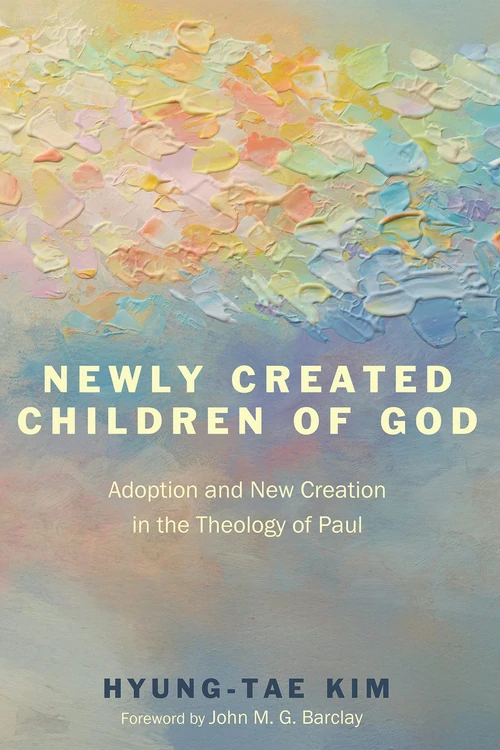
Newly Created Children of God
Adoption and New Creation in the Theology of Paul
- Theology
- Publisher: Pickwick Publications (Wipf and Stock)
- Published: 2025
FritzSearch.com earns a commission on purchases made through Bookshop.org links.
Publisher's Description
This study makes an original contribution to our understanding of the connection between Paul's language of "adoption" (huiothesia) and his concept of "new creation" (kaine ktisis). Although there has been much research on Paul's use of the adoption metaphor and of his concept of new creation, no previous study has paid close attention to the connection between them and what this relationship means for the shape of Pauline theology. For example, recent studies of ethnicity in Paul often appeal to Abrahamic sonship or divine sonship in Romans and Galatians, but the sense of new creation is virtually absent in the arguments. The present study attempts to rectify that oversight through a dialogue with the "Paul within Judaism" school of scholars.
Endorsements (2)
Foreword
“In recent decades, there have been several explorations of Paul’s language of ‘adoption’ (huiothesia) as his theological application of a Greco-Roman legal custom. But it is striking that Paul uses this term in relation to Israel (Rom 9:4), and this makes one wonder: what would be the resonances of this term, or of the concepts it evokes, within the Jewish tradition? Dr. Hyung-tae Kim explores this question by canvassing a broad range of Jewish sources from the Second Temple period and by careful attention to the key Pauline texts. The result is fresh and significant for all studies of Pauline theology.”
“In this monograph Hyung-tae Kim asks whether Paul’s ‘adoption’ language refers primarily to Gentile inclusion in the covenant people of Israel, or to the more universal context of the new creation. Kim argues persuasively and effectively for the second view, with important implications for the fundamental shape of Pauline theology.”
See something wrong on this page? Report a problem