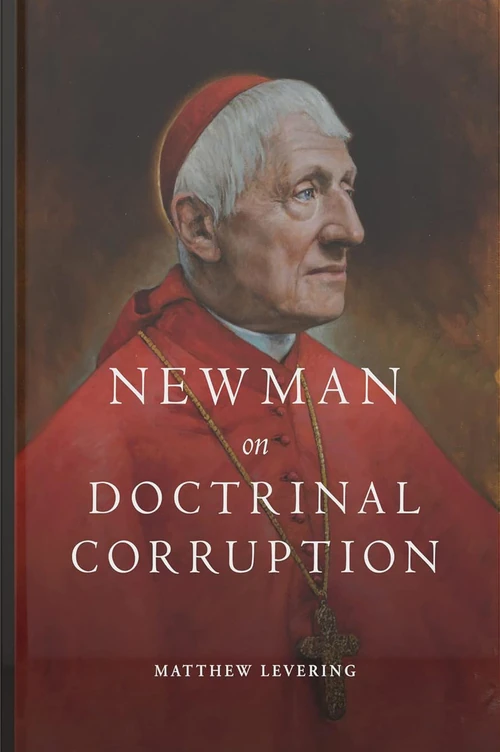
Newman on Doctrinal Corruption
- Theology
- Publisher: Ignatius Press
- Published: 2022
FritzSearch.com earns a commission on purchases made through Bookshop.org links.
Publisher's Description
Newman on Doctrinal Corruption examines John Henry Newman’s understanding of history and doctrine in his own context, first as an Oxford student and professor reading Edward Gibbon and influenced by his close friend Hurrell Froude, then as a new Catholic convert in dialogue with his brother Francis, and finally as an eminent Catholic during the controversies over the dogmas of the Immaculate Conception (in dialogue with Edward Pusey) and papal infallibility (in dialogue with Ignaz von Döllinger). Author Matthew Levering argues that Newman’s career is shaped in large part by concerns about doctrinal corruption. Newman’s understanding of doctrinal development can only be understood when we come to share his concerns about the danger of doctrinal corruption—concerns that explain why Newman vigorously opposed religious liberalism. Particularly significant is Newman’s debate with the great German Church historian Döllinger since, in this final debate, Newman brings to bear all that he has learned about the nature of history, the formation of Church doctrine, the problem with private judgment, and the role of historical research.
Endorsements (3)
“Levering shows us that doctrinal corruption is a very real possibility and that this possibility preoccupied Newman and his interlocutors. Levering highlights a number of parallels between Newman’s day and our own, including similar theological challenges that Catholic theologians must confront. It is refreshing to read a theologian who reads Newman with wider theological concerns than simply accurately reconstructing Newman. The scholarship is solid, the writing clear and, at times, gripping.”
“This is an important volume for Newman studies in particular and theology in general. St. Newman’s theory regarding doctrinal development has been massively influential in Roman Catholic theology and doctrinal promulgations from the mid-twentieth century forward. Yet Newman himself was concerned with a plausible understanding of authentic development carried out within―and safeguarded by―the Church; this indicates clearly Newman’s concern with doctrinal corruption, a topic that has deserved far greater attention and focus. Levering’s erudite work helps to address this lacuna through substantial chapters analyzing Newman, his contextual framework, and his contemporaries, with significant implications for theology today.”
“Matthew Levering offers a significant contribution to a neglected topic. Doctrinal corruption was of fundamental concern to Newman and has lost none of its relevance today. Levering’s focus on key interlocutors is genius: it does full justice to the personal cast of Newman’s thinking and makes for a good read. This is theologically engaged Newman studies at its finest.”
See something wrong on this page? Report a problem