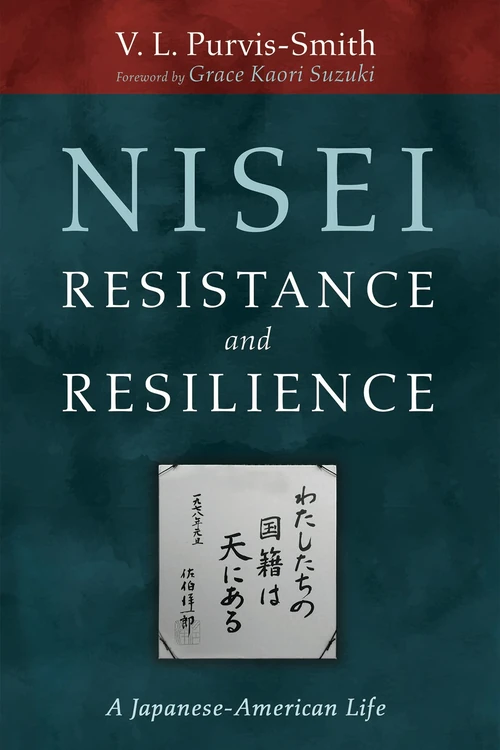
Nisei Resistance and Resilience
A Japanese-American Life
- History & Biography
- Publisher: Resource Publications (Wipf and Stock)
- Published: 2021
FritzSearch.com earns a commission on purchases made through Bookshop.org links.
Publisher's Description
Teenage Allen Maruyama internalized the hostility directed at Japanese/Japanese Americans subsequent to the Pearl Harbor attack. He says he learned to hate himself and "felt subhuman," but Presbyterians in his home state of Colorado "befriended" him. He proved himself as a student athlete and US Army Buck Sergeant. He graduated from McCormick Theological Seminary (MA, Christian education, and MDiv). His MTS is from Dubuque Seminary. Only when he earned a PhD in theology from the Aquinas Institute of Philosophy and Theology did he feel "emancipated," no longer suffering from shame while living and working as a Japanese American in white majority culture. Allen's Nisei (second generation) experiences and his issho kenmei personality (all in, full throttle, nonstop) propelled him into centers of change and controversy in fields as diverse as social justice, theology, and cultural and church history. Dr. Allen Maruyama is the first Asian American to stand for the position of moderator of the General Assembly of the Presbyterian Church (USA).
Endorsements (6)
“This powerful biography of Dr. Maruyama comes when we most desperately need a reminder of the dark history and continuing legacy of Asian American racism in the United States. Purvis-Smith has written a meticulously researched and entertainingly crafted story of a beautiful soul whose resistance and resilience are inspirational. Through Purvis-Smith’s captivating retelling, we witness Maruyama’s struggles against discrimination and other challenges to live an authentic life of service while in search of eternal truths.”
“In this moment, with our country riven by centuries of division, we must find stories to help us understand our common humanity. Purvis-Smith has found the perfect grain of sand in which we can see our world. Her compassionate, unflinching interpretation of the story of one man, Allen Maruyama, allows us to understand the forces that have divided us and, even more importantly, the ties and commonalities that unite us in our diversity.”
“This book is an insightful exploration of one Japanese American man’s journey from his youth in rural Colorado, overcoming the overt and subtle discrimination in mid-century America, to become a gifted and sought-after pastor in the Presbyterian Church, and his attempts to scale the heights of its leadership. Purvis-Smith’s thorough and sensitive depiction of Allen Maruyama’s life reveals the struggles and triumphs he experienced as he sought and succeeded to serve those in need and to address many of society’s ills and challenges, including racism, penal reform, homelessness and disengaged youth. His admirable personal traits and inspiring journey of resistance and resilience are comprehensively, carefully, and elegantly showcased in these pages.”
“Allen Maruyama, the son of Japanese, Buddhist sharecroppers, is embraced by Colorado neighbors and a small-town Presbyterian church. However, he confronts the racism of the surrounding community following Pearl Harbor and struggles with internalized self-hatred. His spiritual journey takes him on a ‘trail of discrimination,’ but he experiences his own healing as he ministers to others. Purvis-Smith does a beautiful job of describing his complicated, inspiring, and compassionate life.”
“Rep. John Lewis suggests we cause ‘good trouble’ in seeking social justice. Purvis-Smith writes ‘good history’ because she invites the reader to look in a mirror and ask the visualized image, ‘What lies are you telling yourself?’ ‘If only I had lived in Las Animus when the Japanese Americans were being incarcerated, ridiculed, and persecuted I would have been an advocate for justice and kindness to Japanese American citizens facing such painful circumstances’ ‘If only’ is a lie we tell ourselves. Healing begins when we personally commit to ‘next time.’ ‘Good history’ says, ‘Next time is here in our present culture.’ The author invited me to see myself therein reflected in the white space between the words. Love is a verb calling for action now. Love reveals our identity, which requires an active itinerary that writes our legacy. Purvis-Smith writes ‘good history’ that challenges the reader to invest in a new legacy now!”
See something wrong on this page? Report a problem