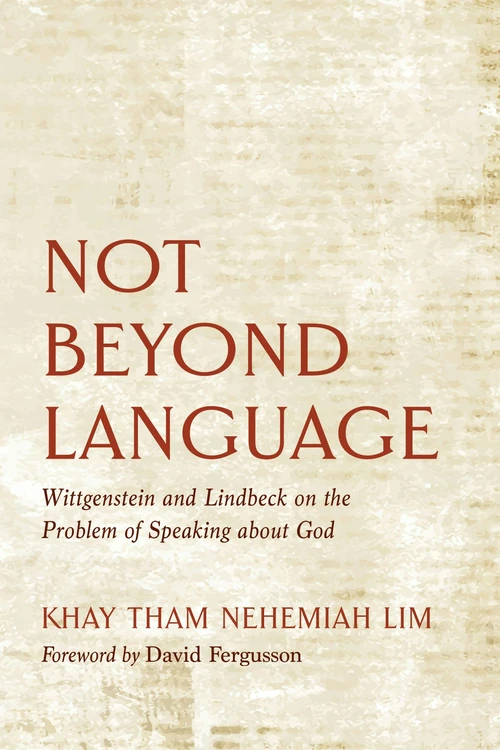
Not Beyond Language
Wittgenstein and Lindbeck on the Problem of Speaking about God
- Philosophy
- Publisher: Pickwick Publications (Wipf and Stock)
- Published: 2021
FritzSearch.com earns a commission on purchases made through Bookshop.org links.
Publisher's Description
The problem of speaking about God arises from the presumed notion that God is utterly transcendent and is "wholly other" from human existence. Moreover, a profound sense of mystery is held to surround God's being. Even so, Not Beyond Language maintains that it is still possible for human beings to express and describe God in words--that language can bring genuine disclosure and understanding of the divine. However, given that religious language is problematic because inadequate, those who engage in speaking about God must accept that the words they use cannot be pressed to yield precise definitions or complete explanations of the divine. The author proposes a nuanced approach to the use of religious language which revolves more around meaning and relevance of the discourse about divine reality, than objective claims about who or what God is.
Endorsements (5)
Foreword
“This is a clear, honest, and balanced study that explores with appropriate scholarly depth the literature on Wittgenstein, Lindbeck, and their significance for theology today. It promises to be a valuable resource for others who wish to explore the nature of religious language.”
“Addressing the difficulty of speaking about God, and religious language more broadly, Khay Lim brings together an astonishing range of theological and philosophical issues. Around his central discussions of Wittgenstein and Lindbeck he weaves an intricate tissue of references, drawing upon thinkers from Aristotle to Augustine, Aquinas, Hume, Heidegger, Rorty, and D. Z. Phillips. This is a deeply learned and profoundly knowing discussion of the matter of ‘God talk.’”
“A theologian with a magisterial grasp of how traditions of religious practice both connect and disconnect with one another, Dr. Khay Lim finds resources for serious ecumenical agreement by proposing how religious believers may steer their conversations with one another along, claims either to inerrancy or infallibility. Both critical and reconstructive, reading this book sharpens up our understanding of the interplay of word and practice expressed in our differences, and consequently how we may relish them in the hunt for truth in theology.”
“In shaping understanding of the nature of religious language, two of the most important figures in the twentieth century were Ludwig Wittgenstein (d. 1951) and George Lindbeck (d. 2018), the former with his notion of language games, the latter with his idea of a cultural-linguistic approach to doctrine. For some, though, their insights are seen as unnecessarily restrictive, a threat to the objectivity of religious belief. In a book which is a model of clarity in both argument and exposition, Dr. Lim brilliantly advances the claim that the exact opposite is the case. A wide range of potential contexts and allusiveness in metaphor and symbol entail a richness of meaning even for centuries-old imagery, while an inevitable lack of precision means only that God is never fully contained by our words, not that truth fails to emerge. This is a work of relevance to conservative and liberal Christian alike.”
“Khay Lim’s attractively written book offers a thoughtful and convincing justification for the claim that it is possible to speak about God, despite God’s transcendence. This is a topic that is of perennial concern to theologians and philosophers of religion. I particularly commend the author’s detailed yet accessible account of Wittgenstein’s contribution to the debate.”
See something wrong on this page? Report a problem