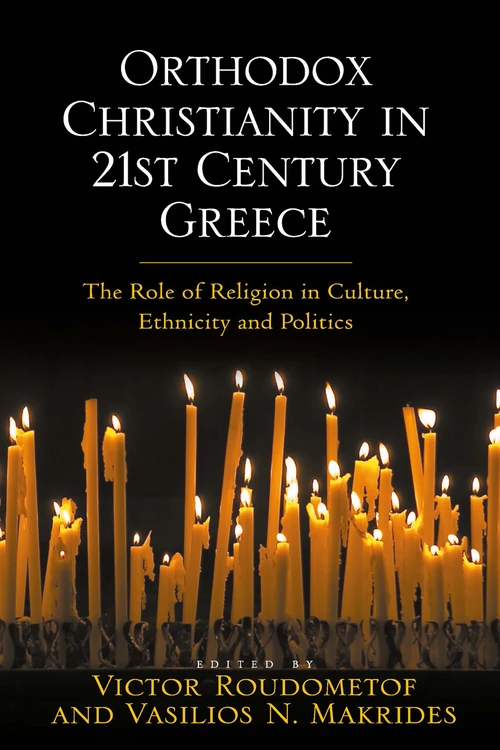
Orthodox Christianity in 21st Century Greece
The Role of Religion in Culture, Ethnicity and Politics
- Publisher: Routledge
- Published: 2021
FritzSearch.com earns a commission on purchases made through Bookshop.org links.
Publisher's Description
One of the predominantly Orthodox countries that has never experienced communism is Greece, a country uniquely situated to offer insights about contemporary trends and developments in Orthodox Christianity. This volume offers a comprehensive treatment of the role Orthodox Christianity plays at the dawn of the twenty-first century Greece from social scientific and cultural-historical perspectives. This book breaks new ground by examining in depth the multifaceted changes that took place in the relationship between Orthodox Christianity and politics, ethnicity, gender, and popular culture. Its intention is two-fold: on the one hand, it aims at revisiting some earlier stereotypes, widespread both in academic and others circles, about the Greek Orthodox Church, its cultural specificity and its social presence, such as its alleged intrinsic non-pluralistic attitude toward non-Orthodox Others. On the other hand, it attempts to show how this fairly traditional religious system underwent significant changes in recent years affecting its public role and image, particularly as it became more and more exposed to the challenges of globalization and multiculturalism.
Endorsements (2)
“This is a deep, masterly and penetrating exploration of Orthodox Christianity in contemporary Greece. Intellectually powerful and methodologically rigorous, the chapters converge in a general cohesion of the cultural themes of the volume which bear directly on the public role of religion in Greek society and beyond. The result is an invaluable contribution to the study of a specific and rather under-researched area of contemporary European religious culture.”
“I welcome this new book that gives more information about the dynamics of Orthodox Church. The authors involved in this initiative are at the top level in the scientific community. I think that the book will be a point of reference for all sociologists of religion, presenting a better knowledge of the relationship between State and State Religion in the Orthodox context.”
See something wrong on this page? Report a problem