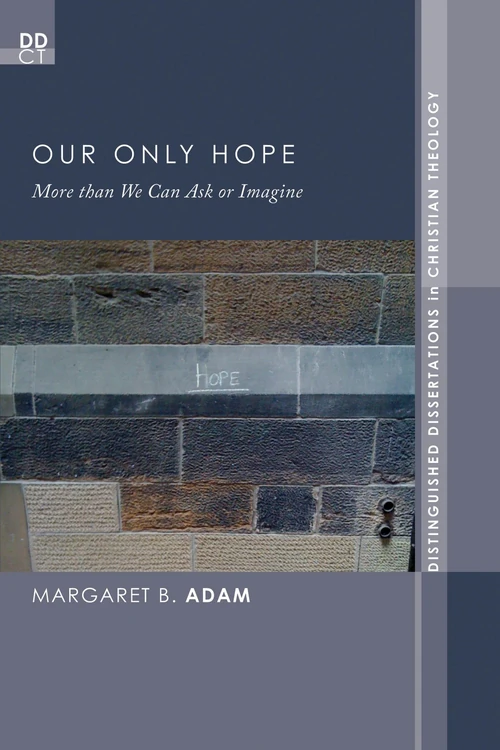
Our Only Hope
More than We Can Ask or Imagine
- Theology
- Publisher: Pickwick Publications (Wipf and Stock)
- Published: 2013
FritzSearch.com earns a commission on purchases made through Bookshop.org links.
Publisher's Description
The most popular source of theological hope for American Christians is that of Jurgen Moltmann. Preachers, teachers, and lay people reflect Moltmann's influence, with their hope in a this-worldly eschatology and a suffering God. However, an exclusive reliance on that hope deprives the church of crucial resources in the face of global economic, environmental, and military crises. This book explores Moltmannian hope and considers its costs before looking elsewhere for additional contributions, from Thomas Aquinas's theological virtue of hope to nihilism and beyond, in order to encourage the church to sustain and practice hope in Jesus Christ, our only hope.
Endorsements (3)
“With uncompromising compassion and clarity, Margaret Adam brings the grammar of the theological tradition to bear on Moltmannian theology. Her theological therapy produces a better theology of hope, one that can engage the contemporary interlocutors of nihilism, lament, disability theology, and feminist theory while also addressing the real sufferings of contemporary persons.”
“In this important and engaging work, Adam rescues theological hope from the limitations of its Moltmannian fashions by recovering much-needed wisdom from the wider Christian tradition. She likewise challenges us to rethink several intractable problems surrounding Christian hope by engaging with several unconventional yet surprisingly resourceful discourses. A most timely book in an age bereft of genuine hope.”
“Our Only Hope offers a fascinating exploration of the complexity of hope from a Christian perspective. Generated from a critical review of Jurgen Moltmann's theology of hope, Adam's work draws upon the riches of Thomist theology to discern a grammar of hope. More than a preference for one theologian over another, however, the book further fleshes out the topic with insights from nihilism, lament, disability studies, feminist theory and feminist theology--a truly groundbreaking move.”
See something wrong on this page? Report a problem