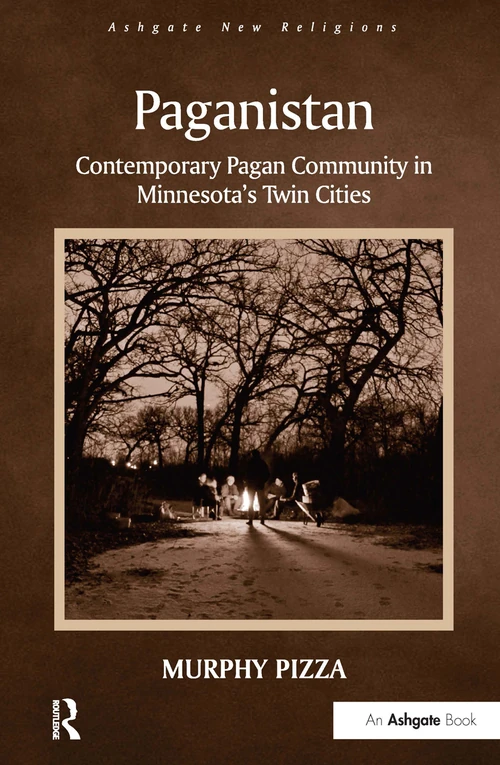
Paganistan
Contemporary Pagan Community in Minnesota's Twin Cities
- World Religions
- Publisher: Routledge
- Published: 2021
FritzSearch.com earns a commission on purchases made through Bookshop.org links.
Publisher's Description
Paganistan - a moniker adapted by the Twin Cities Contemporary Pagan community - is the title of a history and ethnography of a regionally unique, urban, and vibrant community in Minnesota. The story of the community traces the formation of some of the earliest organizations and churches in the US, the influence of publication houses and bookstores, the marketplace, and the local University, on the growth and sustenance of a distinct Pagan community identity, as well as discussions of the patterns of diversifying and cohesion that occur as a result of societal pressure, politics, and generational growth within it. As the first ever study of this long-lived community, this book sets out to document Paganistan as another aspect of the increasing prevalence of Paganism in the US and contributes to the discussion of the formation of new American religious communities. Revealing how canonical theories about community formation in anthropology do not always fit comfortably nor accurately describe how a vibrant Pagan community creates and sustains itself, this book will be of interest to scholars of religion and new religious movements worldwide, and offers a valuable contribution to discussions within both urban anthropology and sociology.
Endorsements (3)
“...a valuable study of contemporary religious life in America. It raises important questions about the consumerist pressures that also pose threats of disintegration to traditional Christian churches.”
“From the first evocative vignette of a meeting of diverse kinds of Pagans to the final reflections on the current state of the garden, Murphy Pizza’s discussion of Paganism in the Twin Cities (Saint Paul and Minneapolis) is eloquent and insightful. Whether Paganistan is unique or not may be debated, but certainly this book provides a fascinating development in the study of contemporary Paganism. It builds on engagement with one ever shifting experiment in late-modern community-building to provide a scholarly assessment that ought to inspire further research about other places and religions.”
“Murphy Pizza is a sensitive guide to the complex fluxes and flows of this diverse urban Pagan community. Her book has much to teach us about the improvisational creativity and particularities of place that shape contemporary Paganism as a spiritual identity as well as a public religion.”
See something wrong on this page? Report a problem