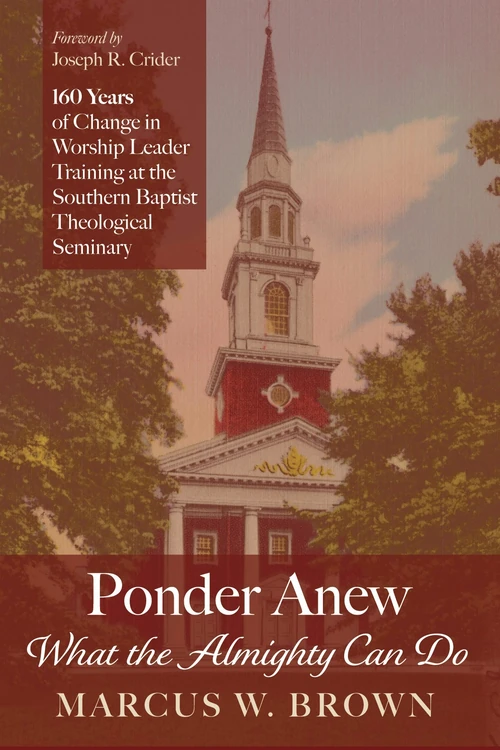
Ponder Anew What the Almighty Can Do
160 Years of Change in Worship Leader Training at the Southern Baptist Theological Seminary
- Preaching & Worship
- Publisher: Wipf and Stock
- Published: 2025
FritzSearch.com earns a commission on purchases made through Bookshop.org links.
Publisher's Description
Institutions represent and pass on philosophies, values, and goals that help define and propagate the cultures they represent. When those cultures experience massive changes, their goals, values, and philosophies are significantly challenged. Over the last several decades, perhaps nothing in the culture of Protestant and evangelical church life has changed more than corporate worship. Institutions called to train leaders for the music and worship ministries in local churches have experienced no less upheaval than the churches they serve. Although the Southern Baptist Theological Seminary has trained church leaders for music and worship leadership in various ways since 1859, the period between 1980 and 2019 arguably saw the most significant upheaval. In the face of changing job competencies, large cultural shifts, and changes in educational philosophy, the faculty and administrators of Southern Seminary honorably manifested Joachim Neander's phrase, "Ponder anew what the Almighty can do." Through its data-infused narrative, Ponder Anew seeks to provide a case study understanding how institutions and churches can fulfill their mission in the midst of significant and sometimes tumultuous transition.
Endorsements (2)
Foreword
“We need this study to help us navigate our future, a future that should be marked by our institutions doing more listening to our churches and less prescribing how they should sound; more focused on preparing students for ministry and less on protecting a particular artistic preference.”
“As historical researchers are reflecting on the contemporary worship movement in America, an easily overlooked component is the story of the educational institutions that found themselves having to respond. Marcus Brown has graciously and thoroughly addressed this gap for the tale at Southern Seminary. Having lived this story, I am thankful to proclaim that he has provided a fascinating account of something that can only be truly understood in retrospect and fairly evaluated by a third party. He has skillfully provided both.”
See something wrong on this page? Report a problem