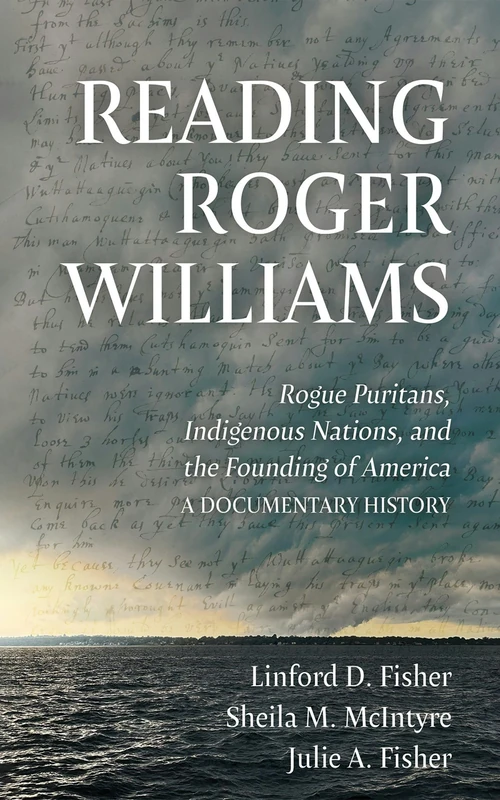
Reading Roger Williams
Rogue Puritans, Indigenous Nations, and the Founding of America—a Documentary History
- History & Biography
- Publisher: Pickwick Publications (Wipf and Stock)
- Published: 2024
FritzSearch.com earns a commission on purchases made through Bookshop.org links.
Publisher's Description
Roger Williams is best known as the founder of Rhode Island who was banished from Massachusetts in 1636 for his dangerous thoughts on religious liberty. But the city and colony Williams helped to found was deep in Native country situated between the powerful Narragansett and Wampanoag nations. The Williams that emerges from the documents in this collection is immersed in a dynamic world of Native politics, engaged in regional and trans-Atlantic debates and conversations about religious freedom and the separation of church and state, and situated at the crossroads of colonial outposts and powerful Native nations. Williams lived among and relied on the generosity of his Narragansett neighbors and yet he was a Native enslaver and part of a process that dispossessed regional Indigenous populations. He could establish a colony based on full religious freedom and yet bitterly complain and campaign against residents with whom he disagreed, such as Samuel Gorton or the Quakers. For the first time, Reading Roger Williams offers readers the opportunity to explore the many facets of Williams's life by including selections from all of his writings, starting with his life in London and ending with one of his final letters, written when he was nearly eighty years old. Each document includes an introduction and annotations to help the reader better understand the text and context.
Endorsements (6)
“Roger Williams is well-known for his insistence on religious freedom. This careful, intelligent anthology highlights another major aspect of his long life as writer, activist, and citizen in New England, his understanding of local Native Americans, and his relationship to the policies—endorsed (or criticized)—of his fellow colonists towards those people. Filled with unexpected evidence at every turn!”
“Who was Roger Williams? You will learn to know him in this carefully curated collection both as a radical puritan who worked for the liberty of conscience as he understood it, and as a self-proclaimed ‘friend of the Indians’ who joined in the settler colonial conquest of Narragansetts, Pequots, and other Native peoples. This is an essential guide to Williams and to the contradictions and cruelties of the seventeenth-century English colonial world.”
“Reading Roger Williams is no mere compilation of an icon’s works. Drawing on the best recent scholarship and placing carefully selected excerpts of Williams’s public and private writings alongside the words of his contemporaries, the authors embed a very human Williams in rich historical contexts. Readers hoping to understand the religious, political, and personal underpinnings of English attempts to colonize Indigenous America can find no better guide on their journey.”
“Roger Williams is among the most controversial figures in colonial America. Some historians dismiss him as almost irrelevant; others consider him enormously significant. For example, W. K. Jordan, author of the classic Development of Religious Toleration in England, said Williams provided ‘the most important contribution’ to the development of toleration in the seventeenth century—a century which included Locke. Reading Roger Williams allows readers to make their own decision.”
“Notoriously cranky, complex, and diverse, Roger Williams shines as a religious liberator and repels as an exploiter of Natives. Prolific, provocative, brilliant, and often dense, his writings both need and reward the insights so richly applied by three deft scholars with deep expertise in colonial New England and its Native context. This collection reveals Williams as the most compelling, maddening, and revealing colonist of his century.”
“Revealing Roger Williams to be a highly capable, complicated, and irascible man who betrayed his own principles without fully realizing what he had done, this excellent documentary history is exceptionally well-conceived. The editors situate carefully chosen documents in historical context to reveal both the idealism and the tragedy of New England’s founding.”
See something wrong on this page? Report a problem