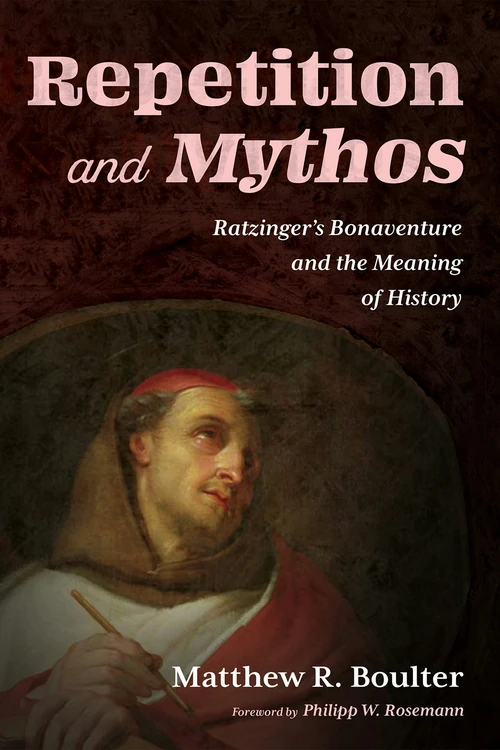
Repetition and Mythos
Ratzinger’s Bonaventure and the Meaning of History
- Theology
- Publisher: Pickwick Publications (Wipf and Stock)
- Published: 2022
FritzSearch.com earns a commission on purchases made through Bookshop.org links.
Publisher's Description
Writing his Habilitationsschrift as a young man in the late 1950s, future Pontiff Joseph Ratzinger argues that, when St. Bonaventure composed his Collationes in Hexaemeron in the spring of 1273, not since St. Augustine's De Civitate Dei contra Paganos had the world seen such a ground-breaking work on the logos of history. Indeed, for Ratzinger's Bonaventure, history is "first philosophy." The thirteenth-century Franciscan rails against the widespread assumption, rooted the newly "rediscovered" Aristotle, of history's unintelligibility. For Bonaventure, mythos mediates the difference between science and history, yielding a non-positivistic approach to the latter. Building on the dynamics of Plato's Line, Boulter show that the days of creation, narrated by Bonaventure, structure both history and thought. Because, like a story, it has beginning and end, history as a whole can be grasped. Hence, eschatological knowledge of the end of the world is possible. Yet this work also shows how the false "progress myths" of modernity are counterfeit versions of true, spiritual advancement of the kind embodied by saints such as Francis and Bonaventure himself. What is the logos of history? It turns out that it is mythos.
Endorsements (2)
“An intriguing and well-composed study. . . . Boulter focuses on the early work of Ratzinger on St. Bonaventure, making a persuasive case that this work was a groundbreaking exploration of the highest order. The theme at issue and its multiple dimensions—namely, the logos in history—recalls St. Augustine’s City of God. Boulter draws Bonaventure and Ratzinger into a living conversation that illuminates both in remarkable and thought-provoking ways. Warmly recommended.”
See something wrong on this page? Report a problem