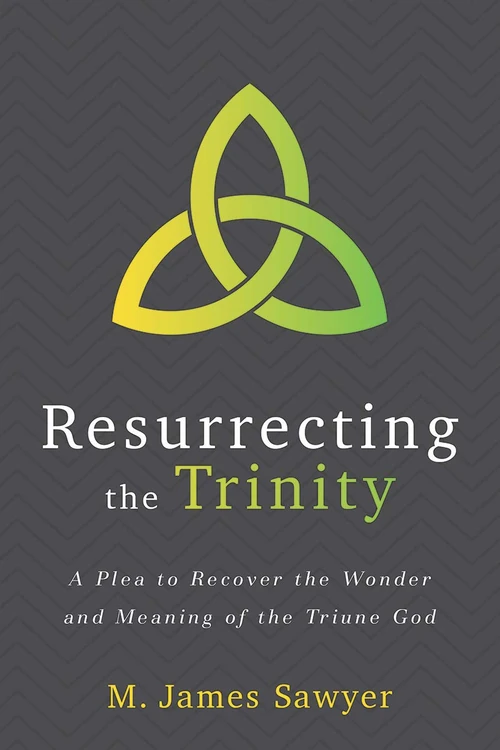
Resurrecting the Trinity
- Theology
- Publisher: Lexham Press
- Published: 2018
FritzSearch.com earns a commission on purchases made through Bookshop.org links.
Publisher's Description
The doctrine of the Trinity confounds many Christians. Because they do not have a proper understanding of this truth, they therefore lack the means to make it meaningful in their theology, worship, and everyday life. Resurrecting the Trinity wants to change this. In non-academic prose, this book explains the fuzziness and apathy surrounding the Trinity. It provides a fascinating and erudite journey as to how it got this way, and then goes on to show how it is the center of everything and how this glorious doctrine exudes with love, vitality, and richness. An expert in historical and systematic theology, the author contends that "the existence of God as Trinity was the central affirmation of the ancient church and the truth from which all other theological understanding flowed. However, for us Western Christians (both Protestant and Catholic) the Trinity has faded into obscurity, the light shed by its reality dimmed to the point of nearly flickering out. While we still verbally affirm the truth of the Trinity, for all practical purposes we have lost its meaning, and in the process lost the biblical picture of Jesus Christ as Lord of creation as well. Were we to deny the Trinity altogether, it is doubtful much would change in our churches on a day-to-day basis."
Endorsements (10)
“The Trinity has rightly come in for sustained attention over the past few decades, as theologians have relearned what we had nearly forgotten, namely, that the Trinity is the ground and grammar of all theology. It is now time for high Trinitarian theology to be translated into language for the churches, and that is what Sawyer is doing in this book. In simple language he explains complex realities and shows why the doctrine of the Trinity is deeply relational and issues out of and then back into rich and intimate worship.”
“Sawyer presents a very lively account of the Trinity, not as abstract theology, but as an explanation of how the one God is the Father, the Son, and the Holy Spirit, three divine persons. He has read widely, writes eloquently, and constantly interacts with modern culture. I was pleased to see he rejects any hierarchical ordering in the Trinity, affirming unambiguously that the three persons are ‘co-equal’ God, as the Athanasian Creed asserts.”
“Without a doubt, although Trinitarian discussions abound in the academia today, the doctrine of the Trinity remains to be highly misunderstood, consciously marginalized, and ignorantly unappreciated by many Christians in the local church. Sawyer makes a passionate appeal to give the doctrine of the Trinity a chance. By intentionally looking at it, he asserts, we will come to appreciate its internal splendor and its many personal, soteriological, and missional implications. Sawyer invites us to prepare ourselves to be dazzled by a beauty that our eyes often fail to notice. Resurrecting the Trinity addresses the most common (mis)understandings and answers the most common questions related to the doctrine. The book’s practical approach makes it like a Trinitarian FAQ page.”
“This is an important work of spiritual theology. Sawyer deftly integrates historical and systematic theology with sound exegesis and relevant cultural references, making the overall work a pleasant read, albeit one requiring focused attention. I heartily recommend this work for colleges and seminaries, pastors committed to deeper discipleship in their congregations and any thoughtful believer who wonders why there is such a gap between official theology and everyday spiritualty.”
“I highly commend this fascinating and highly relevant contribution to Trinitarian studies, applicable both to the theologically initiated, and those less familiar. Eager readers, no matter their background, will gain both theological insight and spiritual encouragement.”
“Sawyer’s theologically meaty book is not for the fainthearted. Sawyer means to confront modern misconceptions about God, ones which cut across numerous denominational lines. In his own words, ‘Failure to come to grips with the Trinity as persons in eternal self-giving relationships of love is perhaps the greatest failure of the Western church.’ Sawyer tackles this problem head-on, digging into Scripture with the help of early church fathers and theologians. Resurrecting the Trinity is a helpful introduction to nuances in Trinitarian thought for the serious Christian reader.”
“To paraphrase Augustine, nothing is as arduous, adventurous, or advantageous as grappling with the Trinity. In this spirit, we vigorously go to the mat for the reasonableness of the doctrine. But frequently we get tied in knots when wrestling with its ramifications for life. With careful instruction and insightful cues, Sawyer ingrains in us a Trinitarian reflex that will strain every sinew of our worship, work, and walk. Indeed, he pushes us to constantly and comprehensively maneuver as one with the Three-in-One.”
“This book is a prophetic call for the church to recover orthodoxy via orthopraxis but abandoning the cliché and the novel in Christianity. How the church does will depend on whether she is willing to heed this call. Getting our God out of our idolatrous box will be a tall task, but it is well worth it.”
“Sawyer calls on a return to the doctrine of the Trinity as the theological root of all other Christian doctrines and as its unifying foundation. He effectively exposes the danger of any expression or belief—direct or indirect—that sees no relevance for this doctrine. The book is rich with the historical development of Trinitarian Christian thought, and shows how erroneous theologians, having conceived God in their fallen imaginations, have dangerously made their theological systems their theological methods. Sawyer’s book is a welcome contribution to help recover any unfortunate disregard for the Trinity.”
“This book explains the Trinity from a base of scholarly work in the Bible and historical theology, but makes it real through his own experience along with examples from movies and stories. I appreciated very much both the theological and relational emphases in the book.”
See something wrong on this page? Report a problem